Sunday, July 05, 1987
Race Report: 1987 Revenge of the Siskiyous
Sunday, June 07, 1987
Race Report: 1987 Rumpstomper
My second race as an expert went a little better than the first, but the result was still a disappointment. After racing so well in May, I really expected to perform better in the Expert class.
Organized by mountain bike legend Bob Shaw, the Rumpstomper was the sister race to the Rockhopper with a slightly different course.
We took off and within a couple minutes Steve and I were sitting somewhere around the top 50. The pace was always very high in the beginning of these Annadel races, and I tried not to get too caught up in it. Sure, there was a definite advantage to being near the front when we turned off the gravel road, but you still needed to pace yourself. There was an 1100 foot climb coming.
When we turned onto the singletrack we entered our element. The trails became more technical and the climbing suited me. We started making our way through the field, picking off riders as the climb progressed.
When we crested the top, I felt like we were doing well. Now the downhilling duo would do their thing.
We blasted downhill with Steve leading the way. Over the years we developed a level of trust so that either of us could lead on a downhill and the other could ride his wheel knowing he would choose the right lines. I alternated between looking past him to get a basic lay of the land and watching his hips to see the subtle weight shifts alerting me to his changes in direction. If he hunched down, I knew he was about to manual over an obstacle. If his head tilted down, I knew a technical obstacle was coming. There were probably many more clues that I innately understood that elude me now as I write.
We finished the descent and picked up a few more places. In the Sport class we would pass MANY riders on downhills, but most of the Experts and Pros were just as fast. Still, we made a net gain.
On the next climb neither of us was as strong. We lost places and even noticed a few Sport riders passing us, which surprised me. After all, I had just dominated the Sport class here at the Rockhopper three weeks ago.
On the second downhill we gained some places back, but not enough. We time trialed the gravel road to the finish and crossed in 35th and 36th overall.
Steve and I both rode well in the early season, but it was clear we had both peaked and were on the fitness downslope. This was all a learning experience. There were so many facets and nuances to training and racing well, and we were still figuring it out. Merely three weeks before on the same trails I felt unstoppable, yet today I didn't have nearly the same power.
Sunday, May 31, 1987
Race Report: 1987 Black Diamond Coal Climb
I would love to say that my first race as an expert was a dream come true—that I triumphed mightily at the next level and was showered with kisses from pretty podium girls. This was not the case. For guys like me there is no fairy tale. I was not blessed with great genetics and muscles. It took over two years of hard work to go from from finishing at the very rear of my first sport race to finally winning. And it quickly became apparent I would need to grind and battle like that once again to be successful in the expert class.
The Black Diamond Coal Climb took place in Clayton, California in what's considered the East Bay, not far from Mount Diablo.
This map on the back of the entry form really cracked us up. It predates the animation used today by Google Earth by decades. Coincidence? Menlo Park isn't that far away . . .
A note for youngsters: Part the the bottom frame is missing because in olden times that's the portion of the entry form we mailed in to register for a race.
The Bay Area races were unique. When we raced in the mountains, the climbs were typically traversed using switchbacks, so the grades weren't crazy. In the Bay Area trails typically went straight up these hills. I don't know what the total elevation gain was for this course, but just adding up the main climbs on this map yields 3240 feet of gain in 19 miles. And I can assure you, there were many, many more short, steep grunts that do not show up on this elevation profile.
The first climb was a six-mile slog averaging about 3.8% in grade. It was slow and awful, and it killed my will to live. I seriously said out loud that I would never race again. I don't have any pictures of my own, but I found this one below that illustrates what we were dealing with quite well.
![]() |
| Photo: mountainbikeroots.com |
We crested the first climb and hit the first descent that had more awful little climbs mixed in. It really didn't feel like we were going down nearly as much as we were climbing. When we finished the second climb I was still racing, but after a short descent we hit the third climb and I went from race mode to survival mode.
I don't remember much more about this race beyond the continuous steep grades and misery. There were no race results sent to us for this race, nor were they printed in NORBA News, but I don't need them to report that I was pack fodder. I do remember that Steve and I both suffered and disliked the course. We likely rode together because misery loves company.
Here are a few more pictures from the race because I don't have much more to say.
![]() |
| Photo: mountainbikeroots.com |
![]() |
| Photo: mountainbikeroots.com |
![]() |
| Photo: mountainbikeroots.com |
As I look back on these races a clear pattern emerges. The triumphs are recalled quite easily while the pain is quickly forgotten. I think as an athlete you have to do that with the bad results in order to focus on the next challenge.
It was only a week after I felt like Superman in Vacaville, but that day I was merely a pretender. After only one race as an expert I was already questioning my ability. Hopefully the familiarity and success I had experienced in Annadel Park would lead to better things at the Rumpstomper.
Later.
Sunday, May 24, 1987
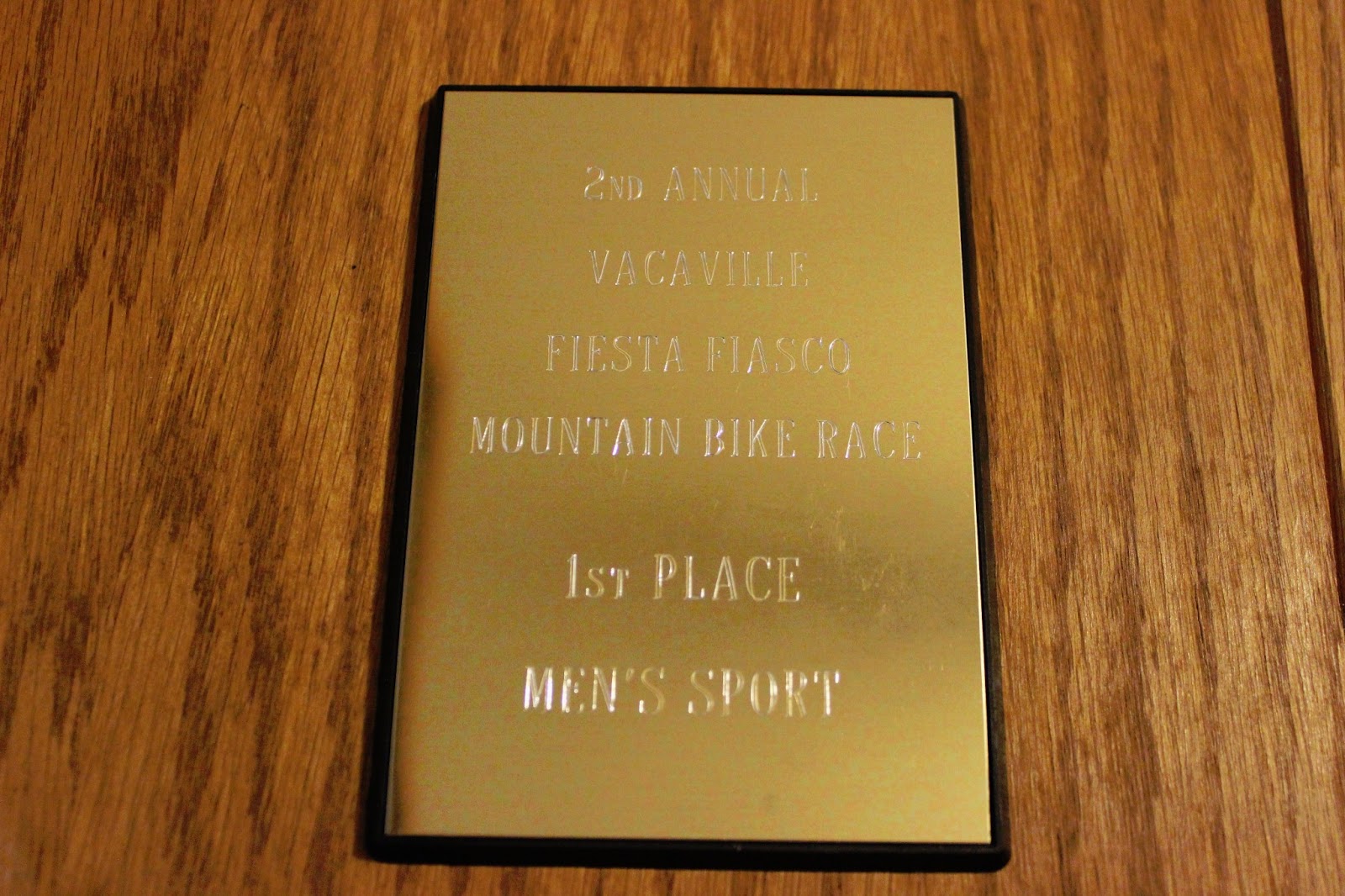
Race Report: 1987 Vacaville Fiesta Fiasco
As we rolled to a stop at the truck, I turned to Steve and said, “I am going to win today.” He looked back at me and said, “Yeah?” I nodded.
Steve was already racing expert at this point, and his race would be after my sport race. I finalized preparations, and with about 15 minutes left before the race, I cracked open a Pepsi and drank it.
When I rolled up to the start, a lot of guys were already staged. Normally you want to get a good spot on the front line, but I didn’t care. I found a spot near the back.
The starter counted down and we were off. I quickly spotted holes here and there and made my way toward the front.
Within a couple minutes I was already in the lead and pulling away. It seemed too easy.
We wound around the park, and when we hit the first big climb I had a big lead. However, about halfway up the climb I took a peek back and saw a guy motoring up to me. As he blew past me at the crest of the climb, I looked down and saw that he only had one gear.
Single speeds were not just rare in 1987, they were practically nonexistent. Paul Sadoff from Rock Lobster crafted his first single speed in 1987, and I know Ibis wasn't far behind, but most people didn't even know they existed until about 1995. We did, because our friend Bob Edwards was one of the single speed pioneers. Anyway, this guy was actually on a converted 26-inch BMX cruiser, and he had just cruised right past me.
The first downhill was steep and fast. I knew I could make up time if I hit the descent hard, so I decided to leave my fingers off the brake levers and just hold on. I quickly made it back to the single speed guy and rode his wheel all the way down.
At the bottom the course flattened out for a while, and I passed him back. We then hit the second climb and he took the lead again. This time I stayed close and rode with him to the top and back down the descent. He was turning a big gear and I just didn’t think he could maintain the pace we were on.
On the second lap I passed him going up the first climb. Again, I descended the hill and did not touch the brakes. My brain fought hard for self preservation, but I willed my fingers to stay clamped to the grips and not grab the brakes. As I bombed past my dad towards the bottom, I heard him yell out, “Slow down!” I smiled to myself as I blew through the finish line. Like my own brain, he was trying to keep me from killing myself.
For the rest of the second lap I steadily pulled away from the single speeder. Going up the first hill on the third lap I went as hard as I could to put some space between the single speeder and myself. Once again I let go of the brakes all the way down the other side. After the race I would learn that the single speed guy crashed into a boulder behind me and broke his collarbone.
I rode the rest of the third lap as hard as I could. When I came through the finish area to start the last lap I had a huge lead. I decided to ride smart. The only thing that could stop me was a crash or flat tire. I rode the rest of the race at a conservative tempo and enjoyed the ride.
I crossed the line for the win, and I was able to hold my hands in the air for the only time in all my races. It was quite an awesome moment.
There were other wins, of course, and more second places than I care to remember. But mass starts, mixed classes and lap traffic always made it difficult to know if I really won. The last thing you want to do is raise your arms in victory and find out you took third.
The awards ceremony was cool. My dad was there, as well as a number of friends. I made quite a haul in swag, but the parts were nothing I could use on my Ibis. The highly coveted Salsa quill stem was of no use since Ibis was already using clamp-on stems. I also scored a set of IRD cantilever brakes, but my Ibis had roller cams. I sold all of it before leaving the race.
This would be my last race in the sport class for a while. I decided to turn expert for my next race.
Later.
Sunday, May 17, 1987
Race Report: 1987 Rockhopper
After back-to-back fourth place finishes in my last two races, I lined up for the Rockhopper with a fair amount of confidence. I was returning to this race for the third time, and I felt like the course suited me.
I spent quite a bit of time on my road bike leading up to the Rockhopper as my hand continued to heal from the Shasta race. The Rockhopper course wasn't super technical, so with a little athletic tape and a pad I made it through just fine.
Like most courses, this one followed the basic starting climb, up and down in the middle, descend at the end model. The first climb was up a fairly mild gravel road to spread things out. I went hard to gain as many places as I could so I was with the fast guys when we turned onto the singletrack.
In the middle section of the course I rode well. This was the only place on the course with technical terrain, and I held my own riding with some of the fastest guys in the sport at the time. I was in the zone and the bike seemed to just gravitate toward all the best lines without any thought.
When I hit the last climb I was feeling exceptionally strong. I started climbing at a good tempo. After a couple minutes, I thought maybe I could do a little more. I shifted to a harder gear and stayed there for a while. Again, I felt good and decided to go harder and shifted again. About a third of the way up I again felt like I had more in the tank. Another gear. When I got on top of that gear and maintained it for a while, I still felt great, so I tried to shift again. And I couldn't.
I peeked back at my freewheel and realized there were no more cogs. I was shocked. Somehow I was ripping up this climb in my 34x13 and it wasn't enough. I eased the chain onto the big chainring and shifted up a couple cogs, then attacked the climb out of the saddle for a bit. When I got on top of the gear I resumed pounding away in the saddle. And it was then that quite possibly the strangest experience of my life happened.
As I ripped up this climb in my big chainring, my mind left my body. Suddenly I was looking down from above, watching myself effortlessly climb at an unreal speed. A surge of euphoria took over me. I can best describe the feeling as a combination of the best hug I've ever had along with the time I had Demerol injected into my IV in the hospital. I was floating on a fluffy cloud, warm and safely in the embrace of the racing gods, and pain was only a distant memory. And then it was gone.
It lasted only a few moments, and then I was back to my customary perspective behind the handlebars as the scenery sped by in my periphery.
I am a man of science. I don't believe in angels, ghosts, wizards or monsters, nor magic or evil spells. Yet this strange event happened and I can't explain it. I had never experienced it before, nor have I since. Perhaps it was as simple as severe oxygen debt, or an overdose of lactic acid. Maybe a huge surge in endorphins. It's possible that reaching the very darkest depths of the pain cave is where one finds true peace. I don't know.
Safely back in my body I continued the climb with what felt like very little effort. Climbing with the intensity of an old lady on a leisurely ride to the market, I was somehow producing elite racing speed.
I crested the climb, reaching the highest point on the 20 mile course. All I had left was the four-mile downhill run to the finish. A gradual decline on a gravel road, suddenly I felt like I was working hard. This is the plight of the skinny bike racer. I was always pretty good going up and down steep trails, but when things flattened out I often struggled.
I felt like I had a real shot at a podium finish so I emptied the tank of what was left. It felt strange to fight so hard to maintain my speed after experiencing such an effortless climb. I tried not to panic when I looked back to see racers gaining on me.
I zeroed in on the rider up the road and buried myself to catch him. It's always better to focus on the prey in front of you rather than the predator behind. Be the lion.
When I caught the first guy I rode his wheel for a few seconds to recover, then hit it hard to blow by. If you look strong when you pass, guys are less likely to put up a fight.
I repeated this process a number of times and picked up a few places while relinquishing none to my pursuers. I finished feeling like I did well. I funneled into the finishing chute where an official ripped my number strip off and added it to the pile in his hand. Another person handed me a mineral water as I exited the chute.
I returned to the finish area after I changed clothes and was not completely surprised to find my tag near the top of the finish board. I had done well overall. I checked and re-checked the board to see if there were any sport class riders above me. There were not. I had won.
Back then the Rockhopper was a big deal for us. Although MTB racing was still in its infancy, the race had already reached a legendary status.
![]() |
| I wasn't nearly this dusty. That's why you fight hard to get to the front. |
![]() |
| It was always cool to see your name in a magazine. |
![]() |
| Here's a short Mountain Bike Action interview with John Tomac. |
Even though it was "only" a sport class win, the competition was tough. Sport was the largest class (73 riders) and often the sport class winner had a very respectable time compared to the experts and pros. Unfortunately I never received any overall results, and the ones provided didn't list my finishing time. But I do remember my tag was pretty high on the board, maybe in the top 20.
![]() |
| Results from NORBA News. Steve took 12th in Expert and Bob won Single Speed. |
Along with being a race, the Rockhopper was also a party. Nobody left after the race and the beer flowed. The awards ceremony was crowded and raucous.
When my name was called, my friends, ABC teammates and other acquaintances went crazy, and it felt good. I looked out at the small sea of racers, the water I was usually swimming in, and decided I very much like the dry land of the podium. I wanted to keep winning.
My prize? A shirt.
Sunday, May 10, 1987
Race Report: 1987 Back Country Ridge Romp
The Back Country Ridge Romp was a race put on by our friend Don McEnhill in the Sly Park area. This was the venue for not only our first race back in 1985, but for many of our mountain bike training rides since then. Steve and I met Don at Back Country Bicycles, a shop in Pollock Pines where he worked. We rode with Don a number of times in the months leading up to this race as he finalized the course. We knew it well by the time race day came.
This was only two weeks after messing up my hand at the Lemurian, and it wasn't healed yet. Fortunately I knew the course wasn't terribly rocky, so I taped up my palm and I don't remember it bothering me that much.
I had a "Rule of 100" for judging how hilly races were, meaning the breakeven point for a "hilly" race was about 100 feet of elevation for each mile. Anything less I considered flat. This course had 3500 feet in 25 miles, so I considered this a climber's (and descender's) course.
Saturday, April 25, 1987
Race Report: 1987 Skyway Shasta Lemurian
Every race has moments of regret unless you actually pull off the win. If you come in 30th, that can be chalked up to simply having a bad day or poor fitness, and it's easy to move on. As you creep up towards the podium, the "what-ifs" become tougher to deal with. This particular race was one of those tough ones to deal with.
If you have ever been to the Redding area you know it gets very hot, and it doesn't cool down much at night. For whatever reason the start of the race was at 10:30 a.m. In only my third year of racing in this area I knew this was too late in the morning. People were going to die.
The Skyway course was basically a long, difficult climb followed by a rolling middle section and a long, punishing descent back to the finish near the Shasta Dam.
Right off the start I was feeling pretty good. I climbed with a group of sport class leaders for a while. As the climb went on, the heat really cranked up. I could see that it was already affecting some of the guys around me.
Back in those days I loved the heat, and riding in it was no big deal. I was young and rail-thin, a snake in the desert pursuing my suffering prey.
Towards the middle of the climb we started absorbing experts and pros who were having difficulty with the heat and the steep grades. I knew at that point I was doing well and maybe even leading the sport class.
As I neared the top of the climb there were racers stopping to the side of the trail. Some dumped water over their heads while others sought shade. Every time I passed someone suffering I grew stronger.
The middle part of the course was fun but uneventful. I remember riding by myself for the most part and not really gaining or losing places. There's probably a little bit of a dark spot in my recollection because the horrible memories of the coming downhill completely overshadowed them, burned into my psyche like it was only yesterday.
I hit the last downhill relatively sure I was in the lead. With descending arguably being my greatest strength, I really felt like I had this one in the bag. Every race adds to your knowledge base, and in this one I learned that nothing is a sure thing.
The trail was mostly chunky andesite rock from Mount Shasta's volcanic past. In fact, there was very little soil at all for the entire downhill—just miles of rock.
Almost immediately I noticed my hands sliding around inside my gloves. Due to the extreme heat, sweat had been running down my arms right into my gloves for a couple hours. They were soaking wet and the leather was extremely slimy.
Soon my left hand, which was doing the majority of the braking, started bothering me. I was getting a hot spot on the edge of my palm between the thumb and forefinger. This wasn't totally uncommon; the occasional blister was part of the game.
The pounding was intense. The trail was rocky as hell and there was no relief. When the pain became too much, I stopped—a very rare occurrence for me during a race. I flexed my hand for a bit while a couple guys passed me. I told myself not to worry; they were likely experts.
I continued going down, albeit a little bit slower, trying to use the rear brake as much as possible. At this point a little blood was flowing out onto my middle and first finger, making things even more slippery as I desperately tried to brake.
I stopped for a second time and dared to take a peek inside my glove. There was a crescent shaped laceration and it looked deep. I was a little shocked because I thought it was a simple blister. All I can figure was my hands were very wet and pruned up, and the soft skin simply split. Meanwhile, a few more guys passed me. At that point I didn't care much until I saw one of them was Jimmy Deaton.
Listen, I understand that Deaton was a fast downhiller. He won Mammoth five times, won a world championship, and he's a member of the Mountain Bike Hall of Fame. But I had ridden with Jimmy a couple times and I was no slouch on the downhills. On a technical trail on cross country bikes, I believed I was every bit as good.
I took off after him and not only held my own, but caught up to him after a few turns. The pain was intense but I refused to let him go. I stayed right on his wheel for a couple minutes, but ultimately it was the pain that did me in, not his speed.
I stopped for the third and final time. I took off my glove and the wound shocked me. It was now a larger half circle and the flap had folded back. The skin was so thick. Under it was what appeared to be uncovered muscle. I saw stars. My hand itself was white and wrinkled up like I had been in a bathtub for hours. I put the flap back in place and continued down the hill as best I could. A number of riders had flown by.
I eventually crossed the line 33rd overall and took fourth place in the sport class. Jimmy beat the first place sport rider, so if I could have stayed near him I would have been OK. If I hadn't stopped at all I would have cracked the top 20 and easily won the sport class. But I didn't. Coulda, woulda, shoulda.
Steve finished behind me in 52nd due to a pretty nasty crash. Someone dislodged a large rock that rolled right in front of him, taking him out. Crashing on those rocks did some damage, leaving him bloodied and bruised.
That spot on my hand eventually healed, although the resulting scar tissue still bothers me on occasion to this day. Luckily suspension forks and disc brakes have helped with the punishment our hands used to take.
It was yet another lost opportunity to score that elusive first win. Still, I knew I had the motor to make it happen even if my hand had failed me. Next up was the Back Country Ridge Romp in Pollock Pines.
Later.