Showing posts with label MTB. Show all posts

Monday, June 29, 2026

The Skinny

Over the last six years the vast majority of my rides have occurred on plus tires, either on one of my two Jones bikes (3.0") or my Salsa Timberjack mountain bike (2.8").


My gravel bike saw little use while I was inFATuated with big tires. Mostly it was relegated to indoor use on the stationary trainer in bad weather. I was pretty content riding slower with the big tires and being more comfortable with the upright position the Jones bikes gave me. I also lived in the foothills surrounded by rocky trails, so the Jones bikes were perfect.

When I acquired the Wolverine in January, I started to mix in a little gravel riding here and there when I wasn't riding with Jennifer (who also rides a Jones). The Wolverine fits me really well and the position is much more comfortable than my other gravel bike. I found that the 55mm tires were a pretty damn perfect compromise for mixed surface riding around my new home area. The bike opened up a fresh way to approach the rides around here that were starting to bore me. It was fun to go fast again.


Then a couple months ago, Jennifer broke her foot. During her recovery I shifted to riding the gravel bikes almost exclusively. As I jumped back and forth between the two bikes, one running 45mm tires and the other 55mm tires, I thought a lot about tires and how far we have come since I first stared riding over 40 years ago.

♦♦♦

My first mountain bike was a 1984 Ross Mt. Whitney. It was a pretty good starter bike and the gateway to my lifelong passion for riding.


At this point in our lives, my friends and I were transitioning from BMX to road bikes. After deciding to buy mountain bikes, we actually rode all three disciplines for a while. It was hard to completely leave BMX behind, but eventually we did as mountain bike fever took hold of us.

My Ross came with 2.125" Snake Belly tires. These tires were pretty common at the time for both BMX and mountain bikes. They looked like this:

This is a Panaracer reissue that stays true to the original.

You can see why they were called snake bellies.

The mountain bike guys simply borrowed the 26" version originally made for BMX cruisers. Here is Tom Ritchey rocking a pair of red snake bellies in 1981:


In BMX we basically had two tires sizes to choose from: 1.75" and 2.125" (not counting sew-ups and speed rims). In our circle the use cases were pretty clear. We used 2.125 for general riding (jumping!) and 1.75 for racing. There was no way you would run 2.125" tires in a BMX race because they were noticeably slower.

My buddy Steve catching air.

That same mentality prevailed when we decided to race mountain bikes in 1985. We believed that 2.125 inch tires were simply too wide for racing. We weren't the only ones. The 1984 Stumpjumper Team, a purpose build racing bike, came with tiny 1.5 inch Tricross tires.


If they were good enough for the Specialized pros, they were good enough for us. Here we are rocking 1.5 inch tires at our first race:

Doug and I unloading our bikes at Sly Park.

My second race was the 1985 Rockhopper. Those tires are narrow!

Yes, my handlebars are bent.

My fourth race:

Looks like I cut my bars down, which I don't remember doing.

We suffered our fair share of pinch flats that year, many of which could have been prevented with wider tires. But we survived.

By the next season I was on my new custom Ibis using 1.95" Ground Control tires, and they were a huge upgrade in every way.

RIP, Charlie.

I bring all this up because sometimes when I am riding my old gravel bike through a technical section, the 45mm tires can feel woefully inadequate and tiny. Obviously after looking down at a three-inch tire for so many years, a gravel tire is going to look small. And railing a corner with a gravel tire is going to feel a lot different and less secure than a big three-inch knobby.

However, it's all relative. When doing the math a 45mm tire measures out at 1.77 inches. It's funny to me that these gravel tires are significantly larger than my original 1.5" MTB racing tires in 1985. I look at 45mm now and think there's no way in hell I am racing on the Rubicon Trail with these tiny things. But we did. We raced the 1985 High Sierra Challenge on those tiny tires. Not coincidentally, I suffered a high-speed pinch flat on my front tire and hit a tree, resulting in my first racing concussion. (I repaired the flat and still finished the race.)

Thankfully tire technology has improved and science has proven that bigger is better, for the most part. Even road racers, who tend to cling tightly to the old ways, have finally embraced wider tires. Back in the 1980s we wanted the narrowest possible tires, as small as 19mm. We pumped them up to crazy pressures, as much as 120 PSI. They rode like crap and we flatted way too often. Over the years I moved to 23mm, 25mm and then 28mm tires on my road bikes.

My racing bike, late '90s to early 2000s.

Currently a 30-32mm tire is pretty standard in the UCI peloton with even wider choices for more technical races like the spring classics. Tadej Pogacar ran 35mm tires in the 2026 Paris-Roubaix. These measure out at 1.38 inches, not much smaller than my MTB racing tires back in 1985. Crazy.

The UCI rules for road tires are now based on total rim/tire diameter, not width. The cap is a 700mm total diameter. There are a lot of variables involved, but for the most part this limits tire width to about 39mm. The UCI is using a super sophisticated 3-D printed device to check tire width. Incidentally, 39mm is about 1.54 inches. My first MTB racing tires might just fit in the checking tool!


In my first year of cyclocross in 2002 I was running 30mm tires, which is on the low end of road racing standards now. However, the UCI is still enforcing a 33mm maximum for cyclocross, a rule that was in place back when I raced. Why would cyclocross tires be narrower than road racing tires?

I actually understand and endorse the logic here because the point of cyclocross is to test the skills of racers riding what is essentially a road bike on mixed terrain.

District Championships, 2002.

For cross country mountain bike racing, the current standard is about 2.4 inches. The Maxxis Aspen and Schwalbe Racing Ralph are pretty popular options. These dwarf anything we could even dream of in the '80s.


On the gravel side, it's not uncommon to see 2.2 inch tires on race bikes. Manufacturers are currently battling in an arms race to see who can cram the biggest tires into a frame and still provide short chainstays, chainring clearance and a narrow Q-factor. The new Crux 5:


The winner of Unbound this year was running two-inch tires.


I don't think the tire wars have been settled yet. Tires are still evolving and racers are pushing the envelope in an attempt to shave precious seconds from their times. The cycling disciplines are all cross-pollinating and stealing bits of technology from each other. The end result is fatter tires winning races.

Like it or not, these trends trickle down to the general public. You can't go into a bike shop and buy a road bike off the floor with 23mm tires and rim brakes. A typical road bike will be equipped with disk brakes and 32mm tires now.

I for one and happy that I can have my cake and eat it too. Tires now are amazing compared to what I started with so many years ago—light, fast, supple, tubeless and wide. I am thankful to leave all the skinny in the past.

Later.

Saturday, February 22, 2025

the Crash: Part 2

At the time of the crash, I was a busy guy. If there were such a thing as a three-ended candle, I would be burning it at all three ends.

After a brutal first semester in college carrying 18 units, I was now in my second semester carrying a slightly more manageable 16. I was also working full-time as the night manager at Round Table Pizza. On top of that, I was trying to ride as much as possible to prepare for the upcoming mountain bike racing season.

We raced around ten times in 1985 and had a blast, but this was during and after my senior year of high school, and up to that point it was only for fun. I intended to race a little in 1986, but I wasn't that serious about it. I was focused on school first, making some money, and riding when I could. Steve and Doug, however, were going to take it up a notch.

They had both just started the process of having custom frames made by Ibis Cycles. I was envious, of course, but I was fairly happy with the Fisher Montare I had purchased late in 1985. It would work fine for my limited racing aspirations, and it was a major upgrade from the Ross I had raced the previous year.


The path I had been on, the one that seemed so very clear the previous day, had now muddied up considerably. Being a responsible adult and working hard towards some unseen life goal somewhere on the distant horizon now felt very different. Working too hard had nearly killed me. I wondered what the point was. My path suddenly had multiple forks jutting off in all directions.

Steve and Doug visited me the day after my accident and told me about the ordering process for their custom frames. They were excited in a way that nothing in my life had been giving me. Suddenly the fog cleared and my life came into focus: I was going to be a bike racer.

I called Ibis and talked to Scot Nicol, and he described the process and sent me a fit sheet. When it arrived I took all my measurements and filled out the short questionnaire. I made it clear this was a bike purely for racing and racing only. I even had them remove all the eyelets on the dropouts just to emphasize that this would be a sleek racing thoroughbred that would never have a rack or fenders bolted to it like some lowly pack mule. I went to a local autobody shop and picked out a Dupont Imron color—a metallic purple. I threw the fit sheet and a check for $300 in an envelope and mailed it off.

In a matter of weeks a pretty purple killing machine arrived, and it was the most beautiful thing I had ever seen.


In the meantime, I was gathering the parts to build the most perfect racing machine possible given a relatively low budget. There were boutique parts out there that may have been better—WTB roller cams versus the Suntour version I was using, for example—but it was all very solid equipment at the time.

Was I a bit detail oriented at 18 years of age? Maybe.


Even at 18 years of age I was a fairly seasoned mechanic, having built many BMX bikes from the frame up. I already knew enough to buy my own hubs, spokes and rims to build my own wheels. I got them pretty close to the finished product, and my local bike shop fine tuned the spoke tension for ten bucks each.


It all added up to produce my favorite racing bike of all time and the one I had the most success on. Unfortunately, I would get less then two seasons out of the frame before it broke.

I went back to school around 10 days after my accident, and obviously I had fallen far behind. My heart was no longer in it, and within days I dropped out of college entirely. My candle suddenly had only two ends, and the racing end now burned with the fire of a thousand suns. I eagerly looked forward to the first race of season with a new focus. Being a responsible adult would have to wait. I was now officially a bike racer.

Later.

Wednesday, February 12, 2025

Bad to the Bone

As I mentioned before, I am slowly clearing out The Archive. As time goes on, the bike parts in my collection have less and less meaning to me. They are just pieces of metal sitting in boxes.

That said, these parts may still have interesting stories to tell.

In 1986 a kid named John Tomac decided to switch from pro BMX racing to mountain bikes. By midseason he was placing in the races I was attending (3rd place pro at the Rumpstomper in August), and by late season he was winning major races. His ascent into our consciousness was meteoric.

I have a magazine from December of 1986 and Tomac is nowhere to be seen. Endorsements at that point were dominated by Ned Overend and Joe Murray. In an October 1987 magazine, not quite a year later, there are four ads featuring John Tomac.

Although he and I were the same age, it was easy to look up to him. He brought a style and swagger to our fledgling sport that was hard to ignore. And he was already at the peak of the mountain I was trying to scale. I was only 19 years old and dreaming of one day being a professional myself.

Our cycling clothing up to that point was pretty boring, so when I saw the AXO gear, I really liked it.

And before long I was wearing the jersey and gloves.

It didn't make me any faster, but hot damn I looked good.

When he signed the deal with Tioga, suddenly a part nobody really cared about became a thing: The stem.

It was just a stem, but I needed it. Had to have it. I wanted to be bad to the bone.

I bought one and used it. It didn't make me any faster, but hot damn my bike looked good.

For a long time it was one of the "untouchable" parts in my collection because of the connections to the racing days and the culture of the time, but things change. I sold it the other day on Craigslist for a paltry $15, and another piece of my history is gone. I could have auctioned it on eBay and made more, but that's too much hassle for me at this point.


I actually made the decal using letters from some other sticker. You can see the "T" is two pieces. So custom.

Anyway, that's the story.

Later.

Thursday, October 24, 2024

Hidden Falls

For a while now Roger and I have been trying to get together for a ride out at Hidden Falls, but one thing or another prevented it. Last time we had a date set Roger caught Covid. The time before that Jenn had a conflicting appointment, and since we are currently sharing one car (my Camry now lives in Los Angeles with the kid), I had to postpone.

Today the planets finally aligned and we got it done.

I took a look at the map to familiarize myself with the area, but I didn't learn much except there were many trails and they ranged from easy to difficult.

Hidden Falls Regional Park is about eight miles north-west of Auburn. It took me about 50 minutes to drive there from Folsom on winding country roads. I arrived a little high on nostalgia because these roads were part of our vast training grounds when we were younger. The flashbacks were vivid and frequent. Every twist and turn brought a new "this is where" memory, and I thoroughly enjoyed it. The roads and countryside have changed very little except for one important facet: The traffic. Back in the 1980s we could ride 30 minutes between cars passing. Now we would be lucky to get 30 seconds.

I arrived at the parking lot to find the temperature was 12 degrees colder than at my home in Folsom. I forgot about the elevation change, and I was horribly underdressed for 46 degrees.

We took off and started on a long downhill and I was very cold. After a long summer of heat it was shocking. We probably could have started later and at least let the sun come up a bit more.

The trails are mostly smooth and fast, with just enough turning to make it fun.

Hey, look, sunshine!

We took a side trip to the namesake falls, and I was surprised there was any water flowing at all considering the time of year.


Towards the end of the ride I was starting to blow up, and we had only gone 12 miles. Roger was on his eBike and I felt compelled to peg it on every climb so I wouldn't slow him down. I was in a heart rate zone I hadn't visited in a while, and it cost me. I usually ride about 25 miles on my mountain bike rides, and I always climb at a good pace, but not like this.

I opted out of a longer ride and made the last climb back up to the parking lot.

In the end we only did 14 miles but with a solid 1700 feet of climbing. Again, this is significantly less than the 2500 feet I do on my local ride, but not at race pace.

We had a nice lunch at a drive-in burger place in Lincoln after the ride.

It was a great introduction to a new trail system and I look forward to doing it again and not killing myself to prove I am just as fast as an eBike.

Later.

Sunday, August 20, 2023

Catalina Island Cycling Notes

A couple years ago we visited Santa Catalina Island and had a great time. It's a quaint little place offering an international feel while only being 25 miles from Long Beach. The golf cart lifestyle reminded us of Isla Mujeres in Mexico. I did a lot of hiking while we were on Catalina, among other activities, and I often looked longingly at the dirt roads covering the mountainous terrain and wished I had a bike.

We planned to return this year, and this time I decided to take a bike. After doing a little research, I had a basic plan. The first thing you have to do is buy a membership to the Catalina Island Conservancy. The lowest level is "Friend" and it will cost you $35 for a year. This is a requirement to ride into conservancy land, but I really don't know how well it is enforced. Humans are pretty scarce once you ride through the conservancy gates into the interior.

Except for the rich and/or famous, who might take a helicopter or small plane, the island is generally accessed via ferry. There are a few ports to start from and a couple different companies. We chose Catalina Express because we qualify as seniors (55+ is a $3.50 savings per leg) and taking a bike was only an additional $3.50. The Catalina Flyer charges $20 for a bike, so that was an easy choice.

I considered the terrain, which was supposedly smooth dirt roads, and chose my Jones Plus LWB for the trip. It had balding tires, a terribly worn chain and chainring, and wasn't running well in general. After replacing some parts and a tune-up, it was ready to go.


When you board the ferry with a bike, they route you to the back of the vessel where the bike racks are located. The tire slots are maybe 2.4 inches wide, so my three-inch tires had no chance of fitting. Even if they did, my 203mm front brake rotor was going to hit the rack. The guy told me to just throw it in there between the tire slots where there was about an eight-inch gap, ensuring the bike would fall over. "It will be fine," he added. Rather than start my trip with a bent rotor or derailleur, I negotiated to sit on the rack and hold the bike upright for the entire 75 minute cruise. I was ill prepared for this, and received a moderate sunburn before my journey really started. Although I was mildly irritated, it was early enough in the trip to fake a smile:


As the ferry neared Avalon, we were required to go inside the cabin. Again, the guy wanted me to leave it in the rack where it would undoubtedly fall over and bend something. After some back and forth, he let me lay it on the ground next to the rack. I kept my composure. Mostly.

Once off the boat, we made our way towards the condo. One thing about Catalina that I have yet to figure out is how 69 degrees can feel so hot. My son and I continually looked at our weather apps and were consistently surprised by the low temperatures. We've been to Florida, Hawaii, all around Mexico, up and down the California coast, and nothing seems to compare. Weird. I will say that even the locals were commenting on the higher humidity due to the incoming hurricane. Anyway, after a 15 minute walk with our very heavy backpacks, we made it to the condo. My bike found its resting place for the rest of the trip.
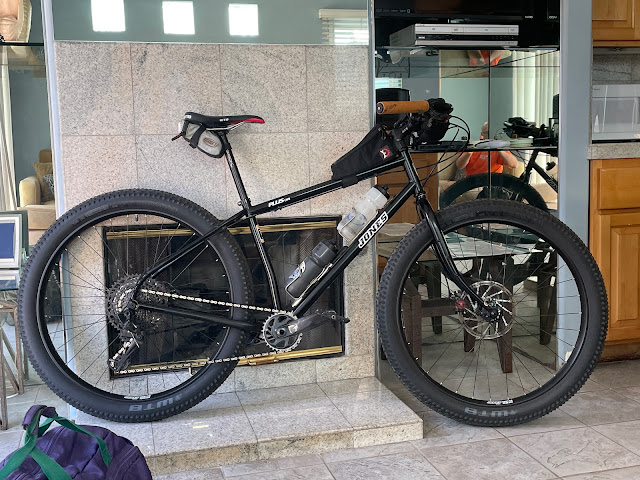

The next thing on the cycling to-do list is to acquire a bicycle permit. Again, this is required to enter into the interior, but free with your conservancy membership. Jennifer and I went to the conservancy office where the guy gave me the requisite "don't pet the bison" speech and provided a short virtual tour of the island on a map (a copy of which I purchased for six bucks). He asked where I intended to ride the next day, and I told him I would start with a ride to the airport. He traced a route naming off streets, which I would never remember, and pointed to a particular road and said, "Here you'll be walking." I responded with, "That ain't happening." He then assumed I had an eBike and Jenn laughed. "No, he hates eBikes." Well, hate is a pretty strong word. I simply prefer the challenge of riding a bike with no motor. And I think anything with a motor ceases to be a bicycle.

With permit in hand we headed back to the condo for a little rest before dinner.


The next morning I headed out for a ride to the airport. The basic profile is pretty simple: Climb to the top of the island spine, ride along the ridge, and gradually reach the high point at the Airport in the Sky.


After rolling slightly downhill from our condo to the bay, the fun starts. The first climb is on a paved road and averages about a 9.5% grade for three miles. Google routed me up Chimes Tower Road, which turned out to be a one-way street, so be aware of that. The correct way to go up is on Stagecoach, also a one-way road, which I did on subsequent rides.

Conditions were cool (64 degrees) and foggy, yet it felt very warm. Within minutes I was hot and sweating profusely as I climbed up the steep road.

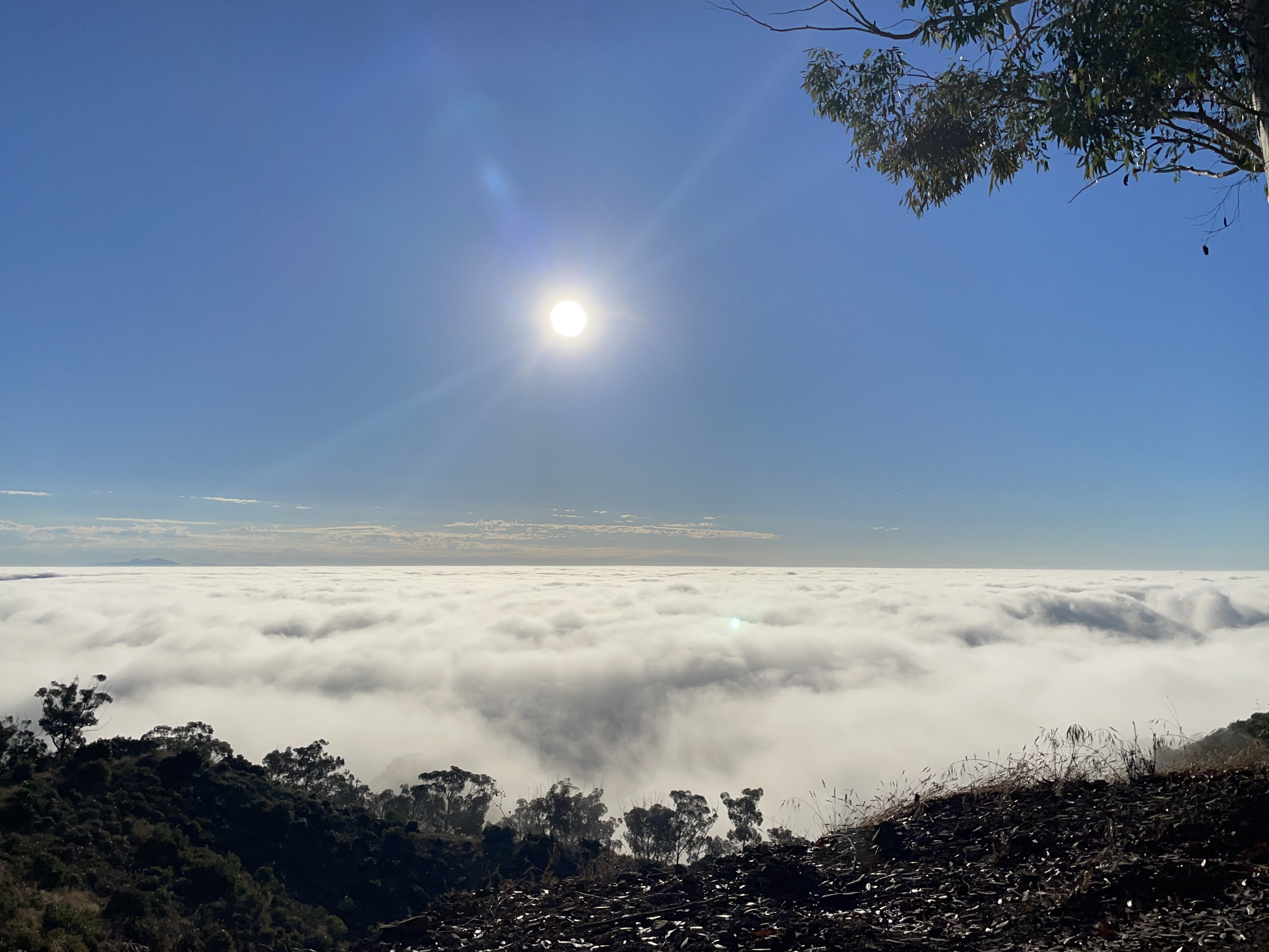
Views were obscured by the fog on the way up, so I did not stop for pictures. I rode straight through to the airport, although I did shoot a few "no-hands" pictures on the fly once I climbed above the fog.


Once you reach the top of the climb, the road turns to dirt for a while. From what I have seen, this is the case for almost all the roads on the island outside of Avalon. Only the road to the airport features any asphalt. For the most part, these roads are graded frequently and are often smoother than the paved road.


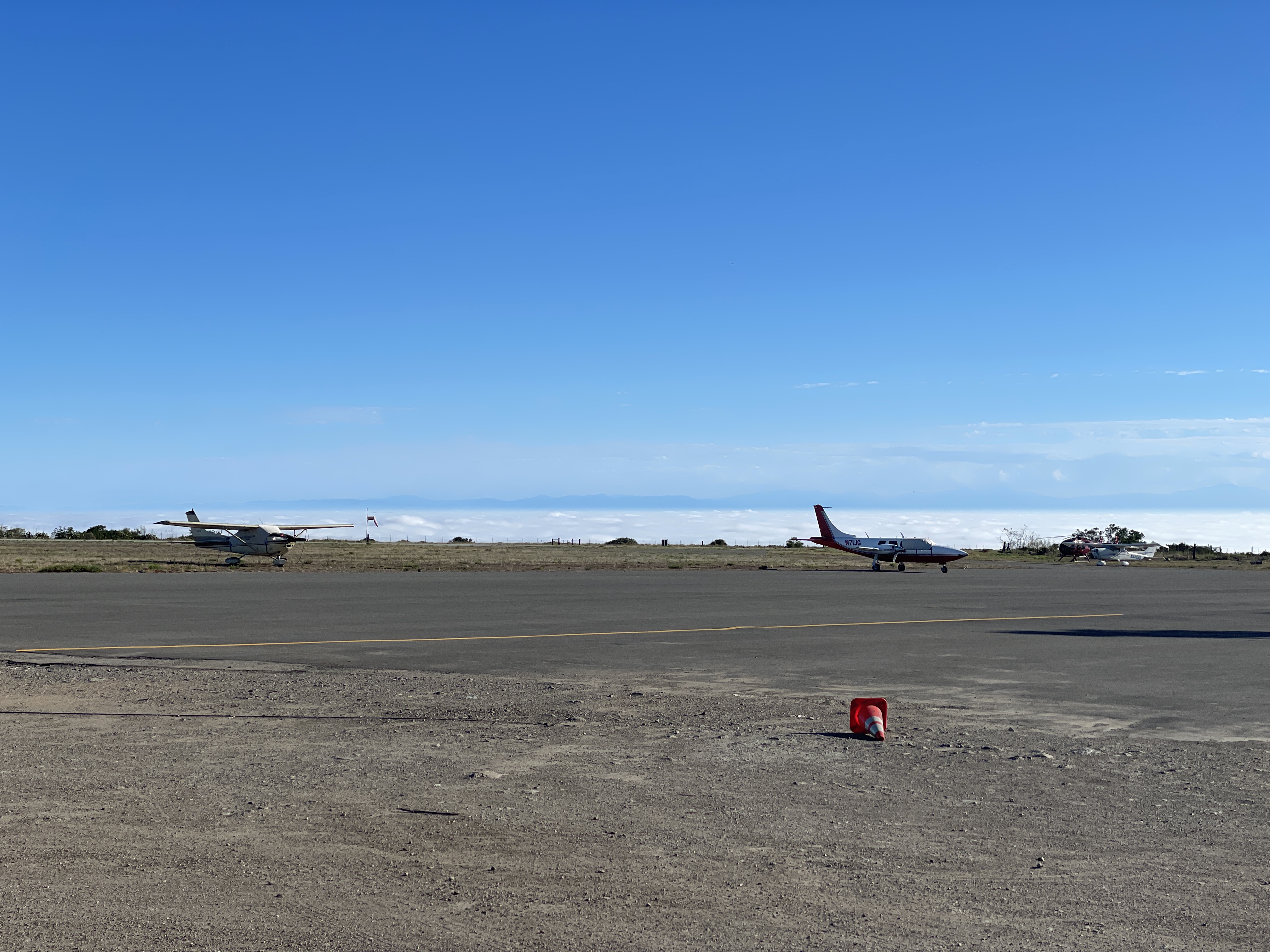
The airport itself is pretty cool. I guess options are limited when the island is basically a mountain peak jutting out of the sea. The only flat spot they could find is up over 1600 feet and 10 miles from Avalon. I can only imagine it's fun to land here.


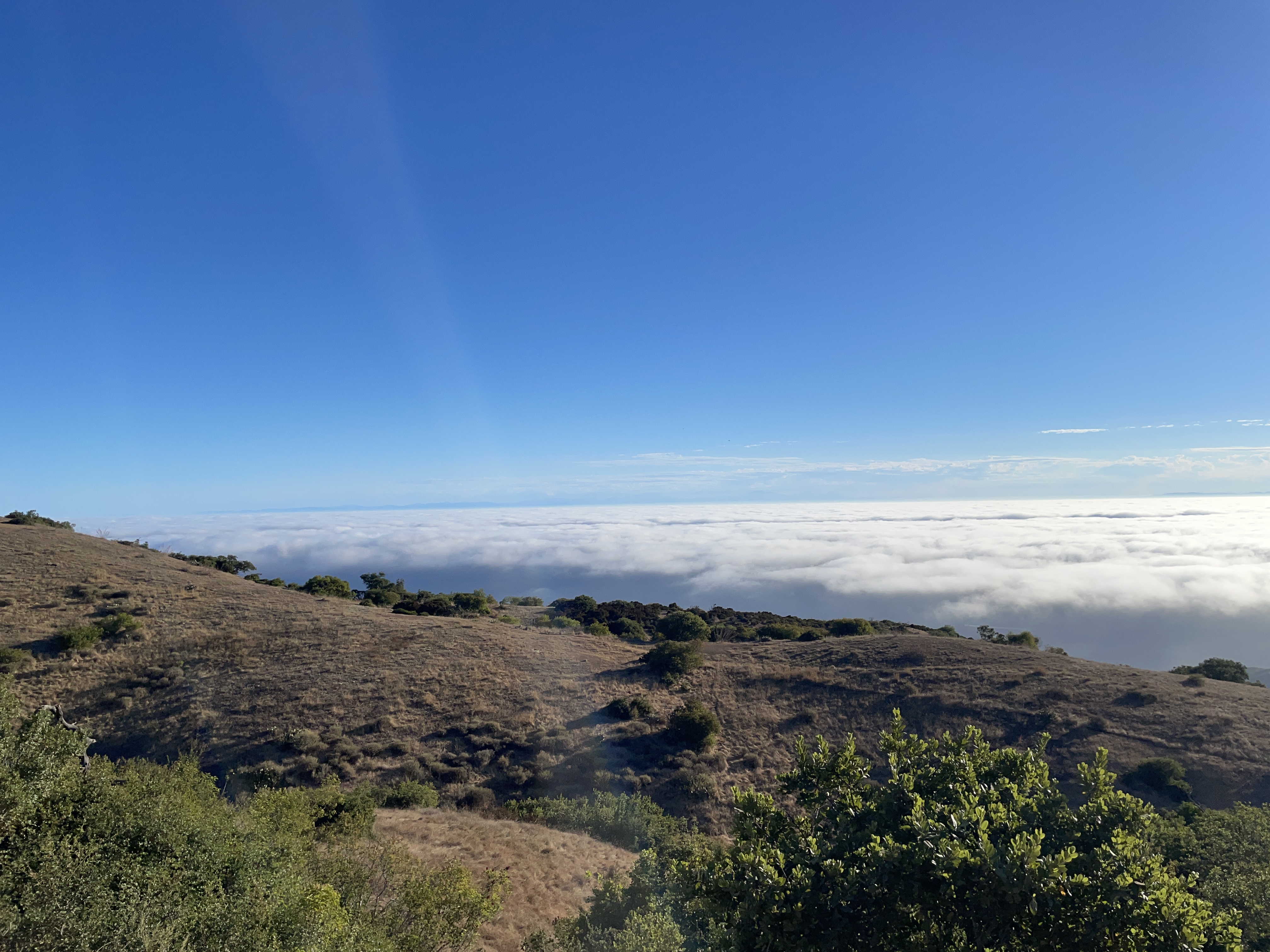
The fog deck below the airport made for some interesting photos.


The obligatory bike shot:


It was really bright up there, so I failed to notice that the posted elevation (upper right) was out of the frame. Next time.

On the way back I stopped for more pictures since the fog was burning off. Here are the famous island bison in the distance:


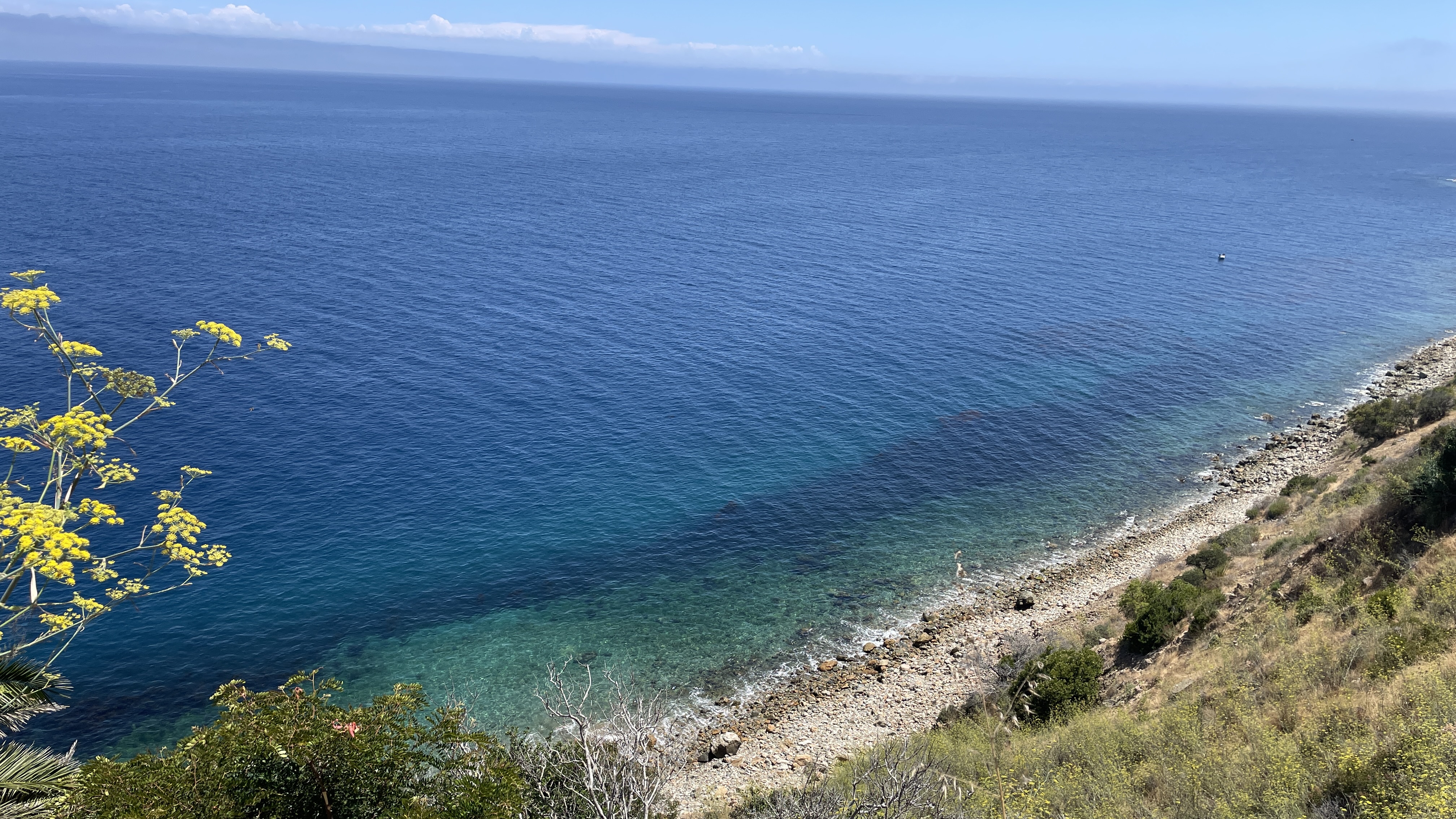
And various views from the ridge:


The ride down was fun, but keep in mind that even in the early morning there will be occasional cars on the narrow road, and golf carts as you near the end. The road surface is rough in places, with blind corners, so keep your speed in check. I maxed out at 30 miles per hour, but I could have easily hit 40 or more. As the day progresses, riders on eBikes, along with buses and jeeps full of tourists, will also be on the road. My advice here is to get out early to avoid the traffic.

Once back, the round trip totaled 20.64 miles with 2520 feet of climbing.

■ ■ ■

And now a slight detour from the cycling content. Later that day we took a little side trip up to a picturesque place to "pick up trash." This is an activity that Grayson and Sierra came up with to leave places they visit in a better place than before they arrived. It's an awesome tradition.


 But there was really another motive for being in that place:


Congratulations to Grayson and Sierra!

Everybody went and it was a great way to end the day.


■ ■ ■

The next day was a planned day off the bike. Jennifer and I went on a morning hike on a trail I found a couple years ago. It wasn't a terribly strenuous hike, but the elevation gain offered some nice views of Avalon.


We returned to find most of our party (ten people in all) heading to the beach. I am not a beach guy, so with nothing better to do I decided on a short ride.

Short is relative, of course. At our new home in Folsom, short is 20 miles with a negligible elevation gain. On Catalina, 20 miles is a serious commitment.

I took off with no route in mind, which is evident from the map:


As you can see, lots of wandering and doubling back. I was on asphalt most of the time, although I was scouting out dirt options for the following day.

The climb on Stagecoach gave me some Vuelta a España vibes.


The long grind up the ridge:


Since it was later in the day, the views were mostly fog-free.


I finished with a paltry 11.73 miles but 1440 feet of elevation gain.

■ ■ ■

On day three I decided to explore East End Light Road, which is a dirt path off of Wrigley Road. On my map it appeared to be a bike legal route, and a sign confirmed that when I arrived at the trailhead. I had aspirations of doing a loop, but I wanted to see how I felt after the first climb.


Like pretty much any ride here starting in Avalon, there is nowhere to go but up:


It was a foggy start. Here is a view of Avalon from sea level looking north:


Once on the dirt climb it was immediately apparent this road wasn't graded as often as others. It was loose, rocky and had washboards in almost every corner. I saw few tracks of any kind, suggesting the road wasn't used much.

One cool thing about islands is how they can have little microclimates depending on elevation, geological features and cardinal direction. This valley was lush and jungle-like, reminding me of the scenery in Jurassic Park. Adding to the visuals was an eerie groaning echoing through the valley, which sounded a lot like the T-Rex from the film franchise. Creepy. It turned out to be some noise emanating from the power plant, but it shook me for a few seconds. Not gonna lie.


It took me a while to get above the fog, which was pretty thick. That's Los Angeles over there somewhere:


As I neared the top, Avalon came into view. This is from a height and perspective that few people probably see:


When I reached the top I had to decide whether to descend down an unknown road and attempt to find a legal way back to Avalon (which may have required another big climb) or play it safe and retrace my route. Even with a Catalina trail map, it's tough to know if a road or trail is bike legal until you actually see the sign.

Since I was going on another hike, I opted to play it safe and head back the way I came.

Unfortunately the fog obstructed what would have been a great panoramic view:


A note on all the "dirt" you see on Catalina: 

If you use Google Earth to scout out dirt riding routes as I do, be aware that Catalina features both dirt roads and fire breaks. Santa Catalina Island has a long history with wildfires, so firebreaks are numerous. As you can see in the panoramic shot above, a fire break parallels the road. These breaks are soft and generally not rideable, often going straight down the sides of hills. Unfortunately they look just like roads on Google, so take care not to think you found a route that isn't really viable.

The descent back down was a little loose and rough. While I enjoyed the descent I had earned, it would have been a lot more fun on a hardtail.

I finished the ride with another meager total of 11.29 miles but with 1788 feet of climbing.

On our hike, my legs were a little weary. Here Jenn catches me resting:


■ ■ ■

On day four I woke up a little tired. My original plan was to ride to Little Harbor, but I knew this would entail at least two major climbs and probably 5000 feet of elevation gain or more for the loop. I didn't know if I had it in me. I opted to start with another climb to the airport and take it from there.

The climb up to the airport was pretty much the same, except this time I used the directional roads correctly. The pace was slow to start, but once I warmed up I felt better. I arrived at the top in 1:28, only three minutes slower than day one.

Given a second chance, the new picture includes the elevation:


On the way back down I took my time and enjoyed the scenery, serenity and solitude. The terrain is awe inspiring, even the second time.


Occasionally a local will interrupt the tranquility, but that's okay.


That's an island fox. It is closely related to the gray fox from the mainland, but much smaller. Six of the eight Channel Islands are inhabited by a subspecies of the island fox unique to the island it lives on. As tiny as this fox was, the Catalina subspecies is actually the largest of the six.


I have a soft spot for crows and ravens. This large raven could probably eat an island fox whole.


I briefly entertained going down Middle Ranch Road, but chickened out after 100 yards when I saw how fast the road was dropping away from the ridge. I just didn't want to do another big climb.


I completed the descent into Avalon and did a little more exploration of the areas to the north that I hadn't seen. I added one more climb up Wrigley Road just because the downhill is so enjoyable and finished up with 26.48 miles and 3222 feet of climbing.

■ ■ ■

After the ride, I told Jennifer I needed to find some sort of straps to tie down the bike for the return ferry trip the next day. She suggested zip ties, which was a great and simple idea that hadn't occurred to me. I went to the hardware store and bought a small package.

As we waited in line to board the ferry the next morning, we received a broadcast alert on our phones to vacate the island. Hurricane Hilary was getting close.


We boarded the ferry and I zip tied the front wheel to the left side of a tire slot. This kept the brake rotor out of harm's way and the bike remained upright and safe for the entire trip.


We said goodbye to Catalina, at least for now.


A few notes:

Cruise ships come in on Tuesday and Wednesday. This obviously increases the number of people on the island. Schedule accordingly when making plans to dine, rent equipment or participate in any organized activities (zip line, snorkeling trips, tours, et cetera).

There is one grocery store, which is Vons on Sumner Street. The prices were a little higher for most food and substantially higher for beer. Still, we saved quite a bit of money by preparing some of our own meals in our rental condo.

As you might imagine, restaurants on an island literally have a captive audience; most are expensive. In the two years between our visits, a few went out of business and one changed from Italian food to American Cuisine, whatever the hell that means. I can't in good conscience recommend any of them except one, which is The Sandtrap. They have a happy hour every day (2-7 p.m.) when tacos are $2 each and also deals on beer and drinks. I probably ate there a dozen times between our two trips.
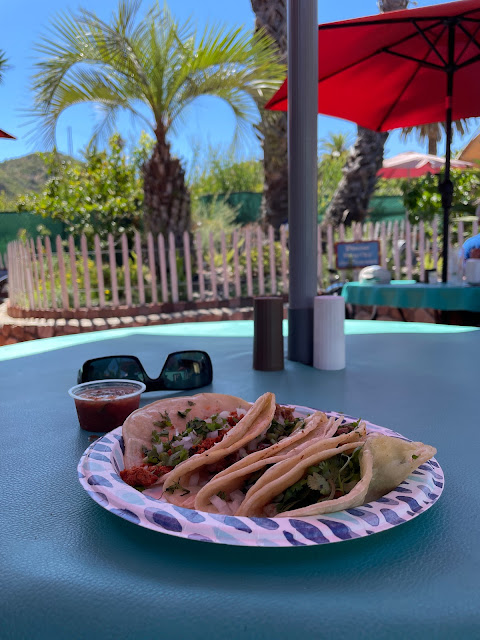

For a first trip with a bike I am fairly happy with the results. Next time I will consider a hardtail simply because the descents are so long. Even a smooth dirt road eventually fatigues your hands on a rigid bike.

I regret not doing a big loop, but I hadn't been on big climbs like these in a few years. As it turned out, I was in pretty decent shape and probably would have been fine. Next time.

Later.