Showing posts with label Review. Show all posts

Monday, June 15, 2020

Sunrise and Evolution

If I have learned anything over the past few months, it's that even after riding bikes my whole life there is always more to learn.

The human body can be both highly specialized and yet hugely adaptable if given a little time. I am a relatively fit cyclist, and I can hold my own against most people my age or even younger. Pit me against runners at a similar fitness level, and I would fail miserably. I simply don't use the same muscle groups or have the built up capillary infrastructure to deliver energy and oxygen to those running muscles.

When I first started riding the Jones, the position changed enough to where I struggled. I felt slow, and my first rides left my muscles feeling sore for about a week. New muscles were being utilized, and my body was trying to adapt. When it did adapt, I felt as fast and sometimes faster on the Jones.


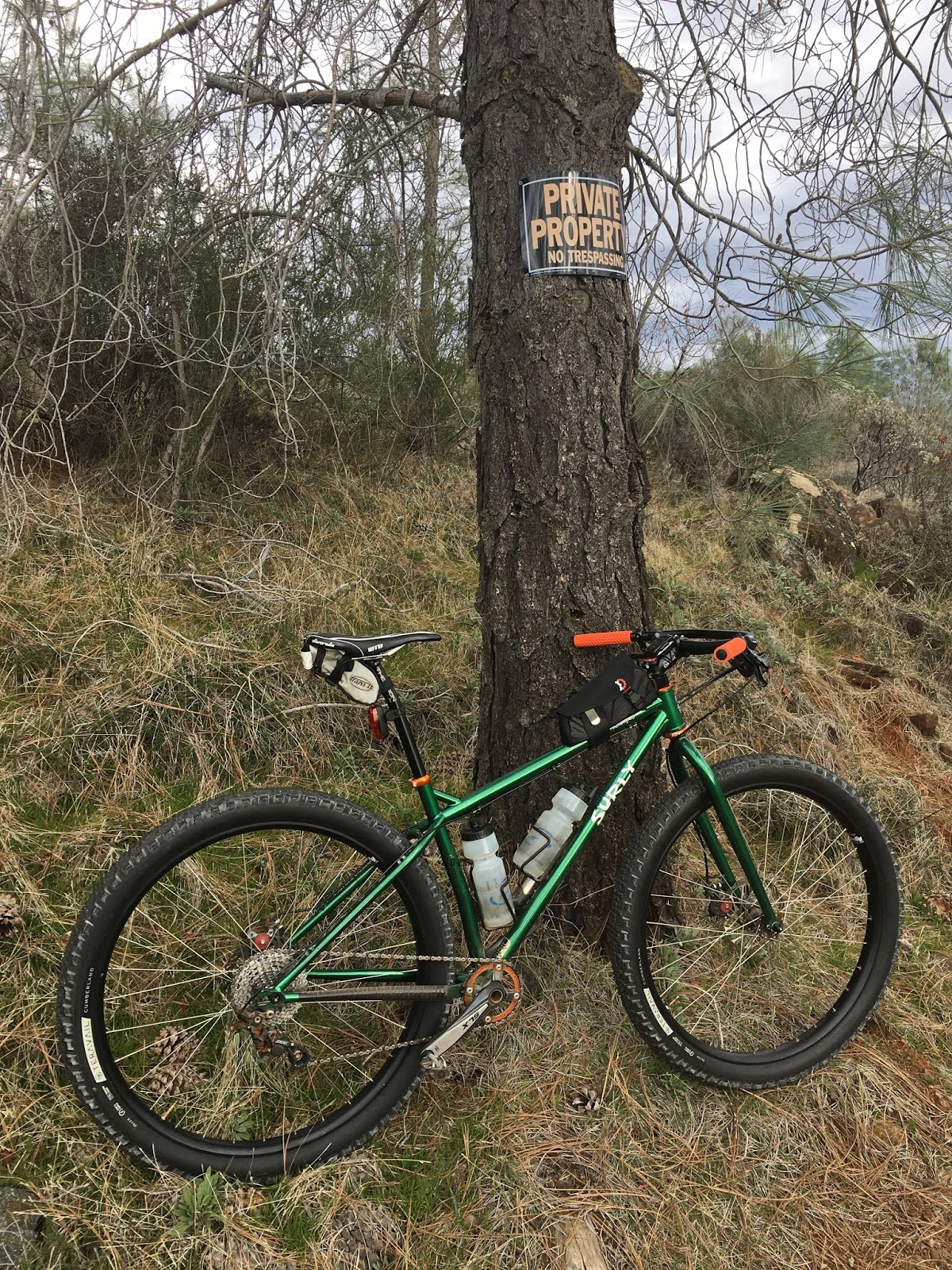
As mountain bikers our genesis and evolution is a complex one. While the origin is often traced back to guys riding old clunkers, the guys who started making the first purpose-built frames had road racing backgrounds. So it's no mystery that the early mountain bikes looked a lot like road bikes. Compare my 1987 Fisher to my LeMond below it:

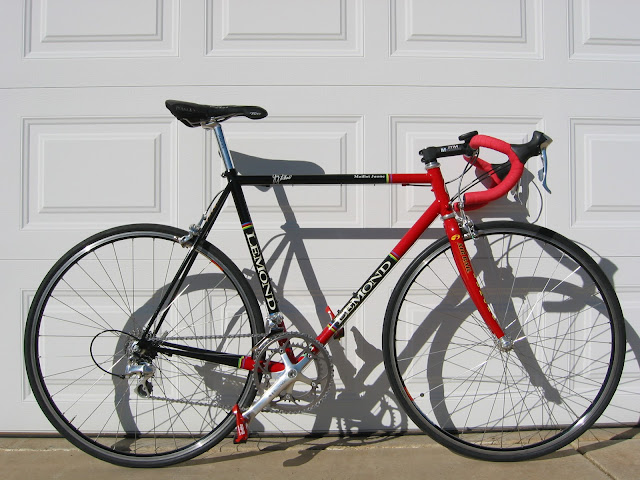

Short, horizontal top tubes, short head tubes and similar angles. We were forced to use ridiculously long stems to compensate, which made early mountain bikes endo machines. We endured these horrible bikes for quite some time because we didn't know any better.

Eventually someone broke the mold and sloped a top tube. Head tubes lengthened. Top tubes lengthened. Stems shortened. Head tube angles relaxed. The world rejoiced.

Which brings me to my recent experiments, which are all being performed in an effort to relieve some stress on my bad wrist and neck. I never intended for the Surly Sunrise bars to go on a conventional mountain bike. They simply looked cool and I thought they might be fun on my 26-inch travel bike. They sat unused for years.

Pain has a funny way of motivating you, though, especially when you are experiencing that discomfort doing something you love. The success of the Jones has opened my eyes to the "might as well try it" school of thought. I eyed the bars collecting dust in the corner of my office and thought, why not? Even if they are wider, taller and have more sweep than any riser bar I have ever used, why not?

On the first couple test rides around my home, they felt strange but not bad. The cockpit was shorter and much taller, and that alone may have been a deal breaker had the Jones not already prepared me for it. The 15 degree bend was a noticeable improvement, enough to relieve some pressure on my wrist but still feel like a riser bar. They were uncomfortably wide, though.

I used them for a real mountain bike ride today for the first time—23 miles on rolling terrain, mostly singletrack. When I rolled away from the car I actually didn't notice the bars at all. I adapted.


On the trail they were great. The entire ride was so much fun. I was really hauling ass down some descents, probably getting in over my head a couple times. But those big bars just made me feel invincible.

Climbing is certainly more upright, but not altogether horrible. On the few occasions when I felt like going fast I simply bent my elbows a bit and attained a more familiar climbing position. But you can also sit up and take a look around if you want, an option you don't have with a low-rise bar.

In the end my takeaway is this: There are a lot of ways to skin that cat. Striving to be more comfortable doesn't necessarily mean giving up speed and handling. In this case, handling and downhill speed actually improved.

So experiment, try different things, keep an open mind (which hasn't always been the case for me) and have fun.

Later.

Thursday, June 11, 2020

The Sun Also Rises

I rode the Salsa with the newly installed Surly Sunrise bars today and it was fantastic. I haven't had so much fun riding in a while.


The bars felt too wide (820mm) and way too tall (83mm), but somehow they just worked.


There are a couple rocky downhills on my local ride and I hit them hard. I really felt like I was flying.

The downside there is climbing feels a bit odd being up so high, but after a while I didn't care anymore. Going fast downhill sometimes outweighs going slow uphill.

Ultimately what I was testing was the 15-degree bend, and that was a success. It wouldn't seem like an extra five degrees would make much difference, but it did. My wrist was pretty happy and I didn't feel like handling was affected at all.

Ultimately something similar but not as wide or tall will probably be my landing spot.

Later.

Sunday, June 07, 2020

Long Term Review - Jones SWB

I guess if you ride a bike enough to wear out a tire and a set of grips, it's time for a review.


I have been riding the Jones almost exclusively for over three months, and for the most part it's been everything I wanted for my everyday bike.


Almost all my rides originate from home, and I utilize my terrible narrow roads, gravel roads, smooth trails and some rocky singletrack. For this purpose the Jones has been pretty good. The upright position and 45-degree bars have virtually eliminated the neck and wrist pain I was experiencing with my other bikes.

This comfortable upright posture may not look like a "performance" position, but once I adapted to it I felt as fast or faster when climbing and almost as fast descending. When climbing, it's really just a matter of moving your hands forward a bit on the long grips, bending your elbows, and letting 'er rip. It's not much different from the classic XC racing position.

Descending so far is a bit different. With the bars so high, and the hands so far back, I don't feel I can attack a technical downhill like I can on a traditional bike. Maybe someday I will get there, but I feel a certain detachment from the bike when picking my way down a rocky trail. Your hands are SO high.

Conversely, on smoother high-speed singletrack the bike is an absolute blast. Too often you hear people say some bike feels like it's on rails, but I don't know any other way to describe it. And there's a good reason for it to handle this way.

While this bike is considered by Jones to be "short wheel base," the chainstays are quite long. Even with the EBB set at 9 o'clock (from the driveside), they come in at 450mm—pretty long by today's standards.


That chainstay length, combined with the low bottom bracket, can be felt when trying to loft the front wheel over obstacles. It doesn't come up as easily as you would think with the bars so high.

Speaking of the bottom bracket, it's low. Really low. Lower than anything I have ever owned before. I have never had an issue with pedal strikes in 36 years of mountain biking, but this bike is giving me fits when trying to ride the occasional rock garden. Granted, Jones specs 170mm cranks, which I refuse to use. I have been running 175s since my BMX days and I am not about to change now. People say you can't tell, but I can. Heck, I can tell if my saddle position changes by a couple millimeters.

Also, until recently I was running smallish 2.8 inch tires that actually came in at about 2.65 inches. Since moving to true 3.0 tires the bottom bracket is noticeably higher. Still, I think the pedal clearance aspect of the bike makes it unreliable as a "true" mountain bike.

The upside of the chainstay/BB combination is super sticky cornering. At high speed this thing just rails corners. It's amazing.

By the numbers, the top tube is relatively short at 23 inches, but when you factor in the bent seat tube and setback post Jones recommends, the reach is actually much longer. It works.


The fork is certainly fun to look at, not so fun to install, and performs just fine. For something so shockingly light, it's actually quite stiff with all the triangulation. If it weren't for the flotation of the plus tires, it would probably be too stiff for me in the dirt. But that same stiffness equates to great handling. You don't really realize how much your rigid fork deflects until you ride one that doesn't. On my Kona and Krampus, you can rub the front disc rotor pretty easily when climbing out of the saddle. I think it would be damn near impossible to do that with the truss fork. The thru axle and 150mm hub also contribute to the stiffness. When you really lean this thing into a corner it does not move.

Now some things I don't like: The water bottle placement is stupid. Two bottles on the down tube was something we were stuck with for a while in the '80s, and I was glad when it went away. Getting either bottle out is a hassle. There was plenty of room on the seat tube to use more traditional bottle placement. Not sure why Jones went that direction.

There are only two derailleur cable guides on the top tube, which leads to some occasional rattling. Every other bike I own has three for good reason. Noises drive me nuts. Using zip ties instead of the plastic clips helped a little.

I am not a big fan of the rear brake mounted on the chainstay. I know, I know, "It's stiffer that way." Well, it's also a pain to get to when installing, setting up or adjusting. Just put the damn brake on the seatstay so I can use my tri-wrench like I can on every other bike.

In the end, the bike has done what I wanted it to. I am more comfortable and putting less stress on my body because I simply believe the position is better. It's made me re-think riding altogether. If I am riding solo, I am no longer bothered by how slow a plus tire is on the road. If my ride takes 10 extra minutes, who cares? I'm not racing anymore. It's just for fun, and being comfortable and pain-free is pretty nice. Hopefully it helps extend my riding for another few decades.

Later.

Wednesday, February 05, 2020

Review: Teravail Cumberland Light & Supple TR 29x2.6 Tire

As I mentioned in the previous post, I was looking to move to a tire that was less ponderous and slow than the 29x3 Maxxis Chronicles.

I had concerns that the bottom bracket would be too low on the Krampus with the smaller tires, but the 60mm bottom bracket drop is exactly the same as my Kona Unit which runs 2.35 inch tires with no issues.

Also as mentioned before, the tires were super easy to set up tubeless. The beads were tight but not ridiculously so. I needed a tire lever for the last few inches, and I am totally OK with that in exchange for ease of seating.

Mounted up, the tires measure out at 2.69 inches at the casing on 39mm ID rims. It's not often that tires measure out larger than the listed size. (I'm looking at you, WTB.) I will say the Teravail website lists the optimum rim width at 29mm, so that's likely how they measure out at 2.6 inches. At the knobs, the diameter is 2.81 inches. Clearance was very tight on the rear end of the Krampus running the Chronicles, so I didn't save a lot of room there.

The profile is decidedly round in the middle but flattens out on the sides.


I felt faster with these tires, and the bike went from "meh" to fun immediately. I can't quite put my finger on the reason, though. The weight savings over the Chronicles is only 55 grams (listed), so it can't be the weight. The raised center section LOOKS like it would help, but at the pressure these tires run at the tread flattens out on the ground anyway.

The casing is definitely more supple than the Chronicles, so I feel like even at the decreased width the tires provide more absorption and comfort.


On the trail the tires roll extremely well. Cornering traction was excellent with the large side knobs and I noticed no weird transition when leaning over. This is often the case with tires that try to be fast and corner well.


One weird feature I noticed during measurements is every third side knob is ever so slightly smaller. The website confirms this "staggering" feature. I am not sure this has any performance benefit, but I am no tire designer.

When I first built the Krampus five years ago I wrote that overall I was disappointed in the 29 Plus platform and felt that the sweet spot would be a 2.7 inch tire. This tire confirms that I was right, because the bike is now, finally, fun to ride.

Later.

Wednesday, January 16, 2019

Double Tap

I like to replace my bike parts every 20 years or so, whether they need it or not. I am weird like that. The parts in question are the shifters on my gravel bike.


I bought these Dura Ace 7700 STI shifters way back in 1998. They have been used on countless bikes over the years, and they have seen a lot of racing.


Frames came and went.


As did styles of racing.


And they saw use long after I stopped racing.


These are only a few examples of the bikes they have adorned. On each bike they dutifully performed their shifting and braking duties without complaint.


But it was time to move on, and time to move into the 21st Century. I looked around and read about what was available out there. All my mountain bikes at this point are utilizing a single ring in front, so I thought I should go that route. In my opinion, Shimano just isn't there yet on the road side. Ultimately I decided to buy my first Sram drivetrain EVER.

I decided on an 11-42 cassette and a 44-tooth chainring. I typically used a 38/48 chainring combo on my cross bikes, so I wouldn't lose much on the high end. On the low end, I would make great gains with the massive 42-tooth cog.


My current gravel frame uses mountain bike spacing (135mm) in the rear. Paired with a road crankset, the cassette is spaced 2.5mm outboard in relation to the chainrings. For this reason I used the outer position for the Race Face narrow-wide ring, and the chainline is spot on.


Setup was pretty straightforward. The only hiccup I encountered was my first chain being too short. I ordered a 120-link chain and it was perfect.


I really like the clean look without a front derailleur.


After over 20 years of shifting with STI, I must say it was frustrating to adapt to Double Tap. At one point I said aloud, "This is #%&@ing stupid." As that first ride progressed, it became easier, and the cussing subsided, but by no means did shifting become second nature.

On the pro side, braking has improved significantly. I think the Sram levers have a slightly higher cable pull ratio, so the brakes felt less mushy and I didn't have to run the pads so close to the rotor. I also liked how much more solid the lever blade feels because it isn't also a shifting mechanism like with Shimano STI.

For the cons, I would say so far using one lever for both shifts is not great. However, I know this is simply because I am not used to it. Millions of cyclists, including top professionals, are successfully using the system without issue.

I worried that the wide range of the cassette might not lend itself to road riding, but I noticed no difference. In reality I simply added two bigger cogs (which I have yet to use) to the nine speeds I was used to for all these years.

Overall I think this will be a fine drivetrain choice. Will it last for 20 years? Doubtful. When I purchased the Dura Ace so many years ago, it was top of the line. This new equipment is pretty far down the Sram food chain. Anyway, time will tell. Either way, it probably outlasts my aging body.

Later.

Monday, July 11, 2016

Freemason

Hmm, I am running out of "mason" references.

Yesterday I took the Diamondback out to Salmon Falls. The last time I rode there I found the terrain to be a bit rough, so I figured it would be a good proving ground for the 27-plus bike.

The bike is still stock except for new grips, which were too thin and hard for my liking. I also converted the tires to tubeless. The rims were already taped, so it was simply a matter of removing the tubes, inserting the valve and adding some sealant. The tires aired right up. By far my easiest conversion to date. The stock tubes were very thick and heavy, and removing them saved 1.5 pounds. Nice.

Since I bottomed out once on the last ride on a much mellower trail, I ran a bit more air pressure due to the rocky nature of Salmon Falls. Right off the bat I noticed a huge improvement in the way the bike felt even with more air pressure. Tubeless tires simply perform better. Losing 1.5 pounds of rotating weight certainly doesn't hurt, either.

I am having a hard time finding any negatives with the 27-plus platform. It might be a little slower than a 29er in some situations, but I can't even say that for sure. To truly compare I would need to have two bikes of equal quality, and the Mason Trail doesn't stack up to my other bikes from that standpoint. Still, it holds its own.

The first part of the ride is mostly flat trail cut into a steep hillside, with plenty of rocks. It's my least favorite part of the ride, but the fat tires made it much better. Almost fun. On the very first downhill I opened it up and let it fly. I can honestly say I have never gone faster on that section. The slack angles and big tires changed my normal hardtail approach from "picking good lines" to simply plowing over everything. It's a different way to ride, and not without merit.

After some fun up-and-down singletrack comes the grind up Flagstaff, which climbs 675 feet in 1.6 miles. Years ago it was a fast fire road downhill, but today it better resembles a rocky, rutted, overgrown creek bed. I spent much of the first half in the 30x36 gear, but had to drop into my lowest gear (30x40) a couple times. I think for the most part I can get up any climb with the single ring setup, especially with the crazy traction of the plus tires.

The second half isn't as steep or rocky. The view from near the top:


The last steep stretch:


After a paved downhill is the back section, which is a fairly smooth stretch except for all the gopher/squirrel holes. If you've ever ridden a squirrel-holed trail, you know it can be a speed sapping experience. It's here where I noticed the flotation of the tires the most.

As I was motoring along, I caught up to a guy on a carbon fiber Stumpjumper FSR. He looked down at my bike, and the look on his face said, "Did this dude just catch me on that Walmart bike?" Yes. Yes, he most certainly did.

I passed him and he jumped on my wheel for a quarter mile or so. On a slight rise I hit the gas and I heard him gurgle something to the effect of "ughndwuh" and drop anchor. Bye now!

After that you enter a section with twisty, flowing trail. It's slightly downhill and fast. I had a blast testing the limits of traction in the corners.


With two rides now on vastly different terrain, I will say this: I think the 27-plus platform is the future. It's that good. You retain the rollover of the 29er diameter, have similar flotation to the 29-plus tire, yet eliminate some of the 29-plus heft I experience with the Krampus.

The ability to have one bike that can run a fast wheelset (29er) and a bomber wheelset (27-plus) is pretty cool, too. And for the most part you don't lose a lot when running the 27-plus wheels anyway. I haven't tried a 27-plus full suspension yet, but the three-inch tires definitely negate many of the drawbacks of a hardtail bike. It's just enough float to take the sting out of the trail.

More to come. Later.

Saturday, July 02, 2016

Stonemason

This morning I swapped out the flat pedals for clipless, taped up the chainstay and installed the GPS mount in preparation for a ride. I have never used a stem as short as 60mm, so the GPS had to go on the bar. It looks weird after always seeing it centered on the stem for so long.


I went out to do a loop in Granite Bay, which is my typical testing ground for new bikes. I parked in El Dorado Hills and rode the Brown's Ravine trail as a connector.

The terrain is mostly rolling with a handful of steep climbs. Soil conditions are sand and silt over hardpack for the most part.

My expectations for this bike were somewhat low considering my experience with the Krampus, a 29 plus bike that is a pondering beast. I figured the Mason would be a blast on downhills and below average everywhere else. Still, I bought it hoping for more.

Goofing around the driveway last night with flat pedals, I thought maybe my assumptions were wrong. It sure felt quicker and more agile than the Krampus, even with the seemingly ridiculous 66-degree head tube angle.

This morning, once my familiar Time pedals were installed and the seat height dialed in, I immediately felt comfortable. Again, after looking at the geometry chart and seeing the straight post and short stem, I assumed a cramped, upright position. Nope. I was quite comfortable in a familiar seated position. Weird.

On the trail it felt like a bike. I say this as a compliment. Once I hit the dirt I really forgot I was on a brand new bike. There was no learning curve or adjustment period. Hills came and I climbed them. Turns came and I carved them. Descents came and I bombed them. After about 30 minutes, I thought to myself, This is what we should have been riding years ago.


As the ride progressed, and I pushed the bike harder in the turns, I noticed quite a bit of tire squirm. The rims are only 30mm wide, and I really think 40mm should be the bare minimum for a plus sized tire. At the pressure I was running, which provided incredible traction and flotation, the sidewalls were not getting enough support in turns. This would really be my only major complaint with the component choices. In my own experiments with rim and tire width, you simply must use a wide rim to get them most performance out of wide tires.


Everything else worked OK considering the price point. Shifting was perfect. The brakes leave a little to be desired, but hopefully they will improve after more break-in time. The fork is adequate.

It's only been one ride, and I just wanted to get some quick thoughts down, but so far so good. I like it.

Later.