Saturday, October 31, 1992

Race Report: 1992 Dash for Cash

I made my triumphant return to racing in the fall of 1992 after a four-year layoff. Although the race wasn't a triumph in terms of results, it was a life-affirming event. Once again, bike racing would change the course of my life.

The race was held in Grant Ranch, a large regional park east of San Jose. I knew from my previous experience with Bay Area races that I was in for a long day of repeated short but steep climbs.


From the time I quit racing in 1988 to earlier in 1992 I had gained 50 pounds. While nobody would call someone 5-11 and 185 pounds fat, I was certainly not the highly trained racing whippet I was before. Basically I would be starting back at ground zero, so I entered the beginner class. When I saw that they were paying down to 20 places, I thought for sure I would be scoring some CA$H.


Because of the weight gain none of my old jerseys fit anymore. Needing a place to carry my tools and spare tube, I had to improvise. I took the largest of my old jerseys and cut the sleeves off, which allowed me to stretch it over a tee shirt. 


The race itself was a couple hours of pain and misery. I had been riding all summer, but much of that was on the paved bike trail. Even when I did go mountain biking, nothing in the Sacramento area really compares to how they build trails in the Bay Area. If there's a hill, the trail will typically go straight over it rather than traversing at an angle or switching back.

My lone goal in this race was not walking any of the climbs. This is not always the way to go faster or race more efficiently. I remember a few occasions when I was dying on a steep climb, refusing to give in to hoofing it, while people were walking next to me expending much less effort. Sometimes pride comes at a price.

I actually felt good about how I climbed that day. The course was no joke and overall I felt pleased with my performance all things considered. But I did pay a price. My brain raced like I did in the old days but with a body built more for pie eating contests. I have raced many times over the years, before and since, but this was the only time I ever flopped on the ground in exhaustion at the finish.


At this point I probably don't need to say there was no CA$H added to my bank account. I managed a lowly 64th out of 189. In the beginner class. How the mighty had fallen.

Still, the fire had been rekindled, the missing piece of my life rediscovered. I didn't know it at the time, but there would be many, many more races in my future. The second act to a play that I thought was long over had been written. I would never be the star I dreamed of in my youth, but every great play needs supporting actors. And sometimes even those guys in supporting roles get their day in the sun.

Later.

Sunday, May 08, 1988

Race Report: 1988 Coors Omnium

After competing in my first road race and enjoying it, I went all-in and built a new road bike. For my second attempt on the road, I was looking for a course that would cater to my strengths, but a race that absolutely did no such thing found me first.

My friend and coworker Don was making his annual pilgrimage to the Coors Omnium held in and around Chico, California. He suggested I go with him, but I was apprehensive. With only one road race under my belt, a stage race seemed like a big jump. Still, he convinced me to go with him. Although I had only been riding with him for a matter of months, and I had barely ridden my new bike, I decided to go for it.

Saturday came and the weather was horrible—windy, rainy and cold. I didn't want to race in those conditions, but when Don called to see if I was ready to go, he excitedly told me how awesome it was going to be. And like an idiot I believed him. He rolled up in his shitty car about 15 minutes later. We took the wheels off my shiny new bike and threw it on top of his in the rear of the car.

I hopped into the passenger seat and immersed my feet in a sea of trash: fast food bags, candy wrappers, soda cans, dirty clothes, receipts, race entry forms, old race numbers, etc. He threw the car in gear and burned out as we pulled away from my house. I am sure my mom felt like I was in very good hands.

I was not.

We drove through Roseville and hopped onto Highway 65 heading north towards Chico. I don't remember the exact model of the car, a Mercury Bobcat, maybe a Lynx, but I do remember it was a piece of crap. The steering wheel had a bunch of play and the brakes weren't great. As we continued north, the rain fell harder and harder.

The painfully slow windshield wipers were no match for the volume of water hitting the glass. I couldn't see much in front of us, but Don was nonplussed. He was rocking out to the music, eating Wacky Wafers by the handful, and barely paying attention to the road. We were on an undivided two-lane highway and Don was hauling ass.

We hydroplaned just outside of Wheatland. The car turned sideways to the right before he corrected our wayward trajectory. Don just laughed, but I was only two years removed from a serious car accident, so I didn't find it amusing at all. On a couple occasions he dug around in his duffel bag behind his seat or rummaged through the glovebox. We came inches from hitting other cars head-on multiple times.

It was absolutely terrifying.

Somehow we reached Paradise, the venue for the road race, mostly alive. The rain continued to pour down. Paradise received a total of 1.45 inches that day, and I think most of that was during my road race.

I registered for the race and only then found out the details. First would be a morning road race followed by a time trial in the afternoon. The next morning would be a criterium in downtown Chico. As a category 4 racer I would be doing 60 miles in the road race. Cat 3s would race 80, and Don's Pro/1/2 race would be 100 miles.

We lined up for the road race and I really had no idea what was going on. I had raced mountain bikes quite a bit at this point, but road racing was very different. I was used to receiving a course map and an elevation profile, but all I really knew about the course was the distance of 60 miles. The faster groups took off before us at intervals, then my group finally went. Suddenly I was thrust into the kind of racing I had viewed on TV for years, and the weather was just as bad as in those European Spring Classics I had dreamed about racing in.

Road racing was very popular back then, and the Coors Omnium was a very big deal. Here's a picture commemorating the 1988 race hanging on a wall somewhere in Chico.

My category 4 group was pretty big, probably four times as many as in my first race. I don't know the actual number, but I would put it at around 80 to 90 riders.

Due to the early crash at Pope Valley, I spent almost all the race with a handful of racers and then the rest riding solo after I was dropped. I had yet to experience real pack racing.

Riding in a large pack for the first time was a little unnerving, especially in the pouring rain. In some respects the rain might have been advantageous for a first-timer because everyone rode with a bit more caution. I don't remember a single crash.

It only took a few minutes before my glasses fogged up to the point I couldn't see a thing. I tucked them into my jersey, but without them all the rain and spray from the tires around me blinded me just the same. I put the glasses back on but slid them way down to the tip of my nose and looked over the top of them like an old man. They blocked the tire spray for the most part.

It seemed like we rolled downhill forever. I was sitting mid-pack and it all felt quite easy. Before I knew it we had ripped off eight miles. Then we started climbing.

I have no idea where the course was located, and there really isn't any way to find out now. What I do know is a tough little climb exists somewhere around Paradise Town Hall.

The pace was pretty high and I struggled at first, but then I started getting into a rhythm and feeling better. We crested the climb and our group was a bit smaller. After a few minutes we came around a turn and there was the finish line. I looked down at my Avocet computer to see we were at about 10 miles. A lap race. And then I realized I would have to do that awful climb five more times.

The pace picked up on the second lap and it no longer felt easy. The pack turned from a shapeless blob to a single-file paceline. I basically knew how to ride a paceline from riding with friends, but this was the first time I had the opportunity in a race. When my turn came at the front it provided some relief from the tire spray, which was nice, but the energy expenditure was high. I did a solid 30-second pull and peeled off like everyone else was doing. It was painful but fun.

We hit the climb for the second time and I had no problem staying towards the front. We crossed the start-finish line and a few more guys were missing from the pack. Forty more miles.

The pace ebbed and flowed for the next few laps. There were a couple solo attacks, but they were easily reeled in. Each time up the climb I stayed near the front, and more guys dropped off the back.

On the final lap the bigger guys were really hammering. Being a skinny guy, I was in serious trouble, barely hanging on. I was actually looking forward to the last time up the climb where the scales would tip my way.

We hit the final climb and the pace actually slowed up. The riders who were pushing the pace on the flats seemed tired. One of the guys who was in the back with me surged towards the front and I followed his wheel. He upped the pace and I looked back to see he created a split. There were only about twenty guys left.

He peeled off and I took over riding the front. I kept the same pace for a bit and felt pretty good. After a short time I decided to drop down a cog and see who could respond. I rode a hard tempo for about two more minutes and peeled off. I expected to slot in after a long line of guys rode by, but the line was quite short. Only a dozen guys left.

We continued to ride hard on the climb and by the finish a few more riders had dropped off. A couple guys made a short, half-hearted sprint at the finish for bragging rights. The rest of us were content with receiving the same time. I counted six guys in front of me.

I had finished my first rainy race unscathed, and had scored a seventh place. In my head I thought this would be the norm going forward, and I would go on to completely dominate road racing. Unfortunately, this would be my best placing in a road race for the remainder of my racing days.

***

After the race I rode back to the car only to realize it was locked. Don had the keys, and he still had roughly 40 miles left to race. I was still so hot from racing that my body was steaming, so I wasn't worried about the rain. It actually felt good. However, as time went on I started cooling down, and before long I was very cold. I waited under a tree, shivering uncontrollably, for almost two hours before Don showed up.

We changed into dry clothes. Bike racing has a funny way of completely lifting your inhibitions. When you are that tired and cold and desperate, getting naked in a parking lot in front of a couple hundred people is the least of your worries. I took my clothes off like I was invisible with no regard for all the people milling about around me.

Don drove to a nearby fast food joint and we ate. I was still cold, eating with my shriveled prune fingers. I had to go right back to the race after we ate because the Cat 4s would go first in the time trial.

When I watched the professionals on TV, the starting order in stage race time trials was based on each racers accumulated time in the race to that point. This would have been nice since I did well in the road race, giving me over an hour to rest and warm back up. Unfortunately our names were posted up on a board and somehow I was one of the first starters. I changed back into riding clothes, put on my wet shoes, helmet and gloves, and warmed up for a few minutes. My name was called to line up. I was stiff, tired and still cold.

After a few minutes of sitting in the rain and getting even colder, the official counted me down and I was off. My heart wasn't really in it, and I felt terrible. Even on the best day, I was never going to be a great time trialist with my slim build. But this was a bad day. I was slow. I was caught and passed by two guys who started behind me. I'm sure I finished towards the very bottom. I never even bothered to look at the results.

After finishing I went back to the car, and I was thrilled to find it unlocked. Don must have been in the vicinity. I took the wheels off my bike and threw it in the back. It was nice to change into dry clothes. Don came back and told me he still had a couple hours until his start slot. We sat in the car and listened to music for a while. With an hour to go, Don got dressed and wheeled away to warm up.

I sat in the car for a couple hours bored out of my mind. It was getting dark outside. Don eventually came back and reported he had done well in the time trial as I knew he would. The guy was fast on the flats.

We again ate some terrible fast food. I remember wondering how Don could be a pro racer and eat nothing but fast food and candy. It still baffles me to this day how he could go so fast on such terrible fuel.

After our gourmet dinner we went to Don's friend's apartment where we would sleep. Don scored the grimy, stained sofa and I was awarded the smelly, carpeted floor. I felt OK with the arrangement because while the carpet stunk like dirty feet, there was no telling what happened on that disgusting sofa. I typically have difficulty falling asleep in strange places, but after a day featuring a hellish car ride, two races and a lot of rain, I closed my eyes and drifted off quickly.

***

The next morning I awoke to brilliant sunshine. Today will be better, I thought. We worked on our bikes and got them running as best we could. Back then bearings were not sealed well, and after a long day in the rain my bike needed a major overhaul. My freewheel was especially cranky and rough. Luckily Don had a pair of sew-up wheels, and he let me use them for the criterium.

The day before had been a long one featuring many hours of soaking rain, cold temperatures, stress and poor nutrition. I finished it up with a terrible night of sleep on a hard floor. And we would start this day with Don's favorite pre-race food: doughnuts.

I was 20 years old and admittedly didn't have a perfect diet. As a bike racer you tend to have limited time between all the training and a job, and you are always hungry. This can often lead to shortcuts. But I did make an effort to get some fruits and vegetables into my body once in a while. Don made no such effort. After spending the better part of two days with him, I was flabbergasted. He was an elite athlete with equally elite junk food tendencies.

I warmed up for the crit and knew it would be a tough day. There are a number of things you need to do for optimal recovery from a previous day's efforts, and I literally did none of them. I emptied the tank the day before and did little to fill it back up.

The race started and the pace was immediately too much for me. I was at the back barely hanging on. The course was very short, so it was basically corner-sprint, corner-sprint over and over. We were shedding riders and the officials were pulling them when it became clear they would not make it back to the pack. After about 10 laps I dropped off the back, and I too was pulled from the race.

Not even finishing was pretty humbling and frustrating for me, especially since I did so well in the road race. I walked away with a new appreciation for professional road racers, especially the guys doing grand tours. Racing hard every day for three weeks was even more difficult to comprehend after doing it myself for only two days.

I changed into street clothes and watched races for the rest of the day. Don's Pro/1/2 race was fun to watch, and he finished near the front.

We drove home and I was no doubt thinking about the upcoming mountain bike races where I would be back in my element.

Later.

Saturday, February 13, 1988

Race Report: 1988 Pope Valley Road Race

From 1985 through 1987 I kept meticulous records of my races. I kept every number and wrote the name of the race, the date, and my finishing place on the back. After that my record keeping slacked off, so piecing together my 1988 racing season has been more difficult.

I recently wrote about the Chico Stage Race, which I thought was my first road race. However, I later found this picture:

The significance is I'm on my Colnago and wearing my old Vetta "CW" helmet. This suggests the race was before I bought my Faggin in late February. In later road races I am wearing a Giro helmet like the guy is wearing in the lower right.

For many years, the race season started with January's Early Bird Criteriums in Fremont before moving to road races in February. I figure this race must have occurred in early to mid February.

I started to remember some details from the race. The course was something like 60 miles with lots of climbing. There was a big crash that split the field. I ended up in the wrong side of the split. We chased and chased but never made it back. Towards the end I was dropped from the chase group and finished alone, somewhere in the bottom third of the field.

I talked to Steve to get his recollections: "I was with the lead group. Then I wasn’t. Then I too had a solo ride from what I recall. And I limped up the final climb to the finish. Yeah that crash was a bummer. First race and we were split."

What I couldn't remember was the name of the race or where it was exactly. Luckily there was someone there to provide some help: my dad. 

He took a lot of pictures that day, but only two of them featured me. This was out of character for my father. Typically he only took pictures of me or my friends. This was likely his first road race, however, so perhaps after photographing so many mountain bike races he thought it was cool to do a road race. 

I combed through the pictures looking for any clues and found this picture with a road sign:

I scanned it at the highest resolution I could and zoomed in on the tiny green sign. I could easy make out "NAPA" and "LAKE CO" with the arrows. So we were dealing with a road running north-south between Napa and Lake County. The bottom sign was a bit tougher. I could clearly see "POPE" in the middle and something ending with an "LY" on the right. Once I figured out it was "VLY" I was in business.

It turned out to be Chiles Pope Valley Road. Since it was a fairly long road, I needed to find the cross street to really nail down the location.

I scanned Google Earth looking for a road that curved slightly to the right before the intersection. It turned out to be Pope Canyon Road. Although the building has changed and a couple trees are gone, you can see that the road and the hill contours in the background match perfectly. The perspective is off a bit, of course, because my dad was standing on the shoulder and Google Street View scans are taken from . . . wait for it . . . the street.

Current road race schedules don't really have anything in the Pope Valley region, so I hit the Wayback Machine.

As far as bike racing goes, the internet started in about 1996. Before that you are unlikely to find anything of use. I went to NCNCA.org and found a 1996 race schedule, and there it was:

The Pope Valley Road Race. The only problem was the late April date didn't jive with my memory and evidence timeline.

I learned that the race promoter was Napa Valley Velo. I poked around and found this little blurb on their archived web site:

The date change comment suggests the race was previously held at an earlier date, so maybe my February recollection was correct.

Anyway, here I am finishing alone after grinding out 60 hilly miles in what I now believe was my very first road race.

Here's one of Steve (the famous blue Descente jersey, white Oakleys) after he finished.

Later.

Sunday, July 05, 1987

Race Report: 1987 Revenge of the Siskiyous

The Revenge of the Siskiyous may have been the low point in my racing journey. The course itself, at 47 miles with 8,000 feet of climbing, would have presented a challenge even at the pinnacle of my fitness. Unfortunately, I was not only on the downslope of my peak but also exhausted.

In late April and May I raced four times, placing fourth twice and winning twice in the Sport class. I was fit and fast and confident. On the last day of May I raced as an Expert for the first time and struggled. I attribute that one mostly to a Bay Area course that didn't suit me well, but I definitely think my fitness was waning. The next day, as the calendar flipped to June, began a hellish month I really regret.

I was working part time at Frank's Bicycle Lane in Roseville, California. My motives for working at a bike shop were pretty simple: Work just enough hours to pay for my racing habit and get the parts I needed at a deep discount.

Everyone had a clear role at Frank's except me. While I mostly built new bikes, I also performed service when needed. I also sold bikes, parts and accessories. My manager, Tony, trusted me and leaned on me for my mountain bike expertise when ordering bikes and parts.

When our service manager, Mark, decided to go to Italy for the entire month of June, I was asked to step in. These were big shoes to fill, both literally (Mark was six feet, six inches tall) and figuratively.

Mark worked full time, and I thought I could pull it off and still maintain my outside life. It was only for a month. What I didn't realize, however, was the fact that when I became Mark there was nobody to become me. So I was expected to put in my 40 hours as the service manager Monday through Friday and still work Saturday, which was our all-hands-on-deck day. We would sell a few bikes during the week, but on a good Saturday we might sell a dozen or more, so it was the day everyone worked.

The mistake I made was training like I did when I was working 20 hours a week. I rode whenever I could, often in the heat of the late day instead of my customary mornings. This pushes back your dinner, your bedtime, your ability to rehydrate, everything. Being young, confident and dumb, I didn't realize what a huge difference there was between 20 hours and 50.

I made it through the month, and I was never so happy to see my tall, grumpy service manager walk through the door.

On the Fourth of July, Steve and I drove up to Ashland, Oregon for the race. The next morning we drove from the motel to the venue. At registration we were handed this:


It was as bad as it looks. Well, for me.

We took off and settled in for 16 miles of climbing. I actually did OK, although at some point I lost contact with Steve, who was having a good day. Still, I felt like I was only a couple minutes behind him. I thought perhaps I could catch him on the long descent.

I crested the top, and I was very happy to begin the long downhill. I was passing people and feeling pretty good about myself. I knew I was a pretty good at going down.

Descending is really great. For a while. But this one went on for far too long. At around the halfway point I actually wanted it to be over.

Eventually it did end and at first I was happy to begin climbing again. Until I wasn't.

Revenge hill was about four miles at nearly a 10% grade. It was tough. You can see it took some of the fastest guys around 45 minutes to go 3.8 miles.


I cracked big time. I never ate in races, and for the most part I didn't have to. Most of the races back then were 25 miles or so, falling within the classic two-hour mark. (Your body typically stores two hours worth of glycogen to fuel your muscles.) This race obviously exceeded that, and I should have brought some food.

Anyway, I crawled up the climb in my lowest gear and even resorted to walking a couple times. I crested the top and rolled into the finish glad the ordeal was finally over.

Steve turned in a fine performance to take 7th place Expert with a 3:53 finishing time. I limped in over a half hour later, taking 22nd place. Somehow I beat six guys, and a feel for anyone who had it worse than me.


Again, another learning experience. I would have been better served riding less in June while I worked so much, and focusing more on rest and recovery.

Now that the month was over, I needed to get refocused and prepare for the late summer races. Hopefully I could rebound and get some good results.

Later.

Sunday, June 07, 1987

Race Report: 1987 Rumpstomper

My second race as an expert went a little better than the first, but the result was still a disappointment. After racing so well in May, I really expected to perform better in the Expert class.

Organized by mountain bike legend Bob Shaw, the Rumpstomper was the sister race to the Rockhopper with a slightly different course.


If I remember right, the first and last thirds of the race were basically the same as the Rockhopper, but we rode the middle loop backwards.


The one big difference between Sport and Expert was the company we kept. When we staged for races in the Sport class, the big names were somewhere up in front of us in the distance. As Experts, we were staged with the Pros. For a few races it was weird to be right next to Joe, Ned, Casey, Max and Tomac. But eventually we realized they were just racers, like us, albeit a little faster.

We took off and within a couple minutes Steve and I were sitting somewhere around the top 50. The pace was always very high in the beginning of these Annadel races, and I tried not to get too caught up in it. Sure, there was a definite advantage to being near the front when we turned off the gravel road, but you still needed to pace yourself. There was an 1100 foot climb coming.

When we turned onto the singletrack we entered our element. The trails became more technical and the climbing suited me. We started making our way through the field, picking off riders as the climb progressed.

When we crested the top, I felt like we were doing well. Now the downhilling duo would do their thing. 

We blasted downhill with Steve leading the way. Over the years we developed a level of trust so that either of us could lead on a downhill and the other could ride his wheel knowing he would choose the right lines. I alternated between looking past him to get a basic lay of the land and watching his hips to see the subtle weight shifts alerting me to his changes in direction. If he hunched down, I knew he was about to manual over an obstacle. If his head tilted down, I knew a technical obstacle was coming. There were probably many more clues that I innately understood that elude me now as I write.

We finished the descent and picked up a few more places. In the Sport class we would pass MANY riders on downhills, but most of the Experts and Pros were just as fast. Still, we made a net gain.

On the next climb neither of us was as strong. We lost places and even noticed a few Sport riders passing us, which surprised me. After all, I had just dominated the Sport class here at the Rockhopper three weeks ago.

On the second downhill we gained some places back, but not enough. We time trialed the gravel road to the finish and crossed in 35th and 36th overall.


While getting inside the top 40 out of 250 starters seems good, this only netted us 15th and 16th in the Expert class. Disappointing. Even worse, we would have been 5th and 6th in the Sport class, outside of the podium. It definitely left me wondering if the Expert class was really for me.

Our ABC teammate Greg Edwards finished a couple places ahead of us. No disrespect to Greg, he was a strong rider, but at this point in our racing careers he should not have been ahead of us.

Steve and I both rode well in the early season, but it was clear we had both peaked and were on the fitness downslope. This was all a learning experience. There were so many facets and nuances to training and racing well, and we were still figuring it out. Merely three weeks before on the same trails I felt unstoppable, yet today I didn't have nearly the same power.

Next up was Revenge of the Siskiyous in Oregon. I was already concerned about this one.

Later.

Sunday, May 31, 1987

Race Report: 1987 Black Diamond Coal Climb

I would love to say that my first race as an expert was a dream come true—that I triumphed mightily at the next level and was showered with kisses from pretty podium girls. This was not the case. For guys like me there is no fairy tale. I was not blessed with great genetics and muscles. It took over two years of hard work to go from from finishing at the very rear of my first sport race to finally winning. And it quickly became apparent I would need to grind and battle like that once again to be successful in the expert class.

The Black Diamond Coal Climb took place in Clayton, California in what's considered the East Bay, not far from Mount Diablo.

This map on the back of the entry form really cracked us up. It predates the animation used today by Google Earth by decades. Coincidence? Menlo Park isn't that far away . . .

A note for youngsters: Part the the bottom frame is missing because in olden times that's the portion of the entry form we mailed in to register for a race.


The course was difficult. Not only was the profile very jagged, but much of the course surface was soft. We encountered gravel, sand and soft dirt. I had already suffered from similar conditions in Mammoth the year before, and I would suffer again.


As someone who believed he was a good climber and descender, when I first saw the course profile I was excited. However, eventually I would learn that not all climbs were built the same. I excelled at two kinds of climbing. The first was rhythm climbs that were not too steep where I could get up to speed and keep it there. Second, I was especially good on rolling climbs where I could go hard, recover, and go hard again. I could seemingly repeat that process over and over.

Conversely, I wasn't very good on very steep climbs. And as previously mentioned, soft surfaces killed me. Add the two together and you get a long, tough day in the saddle.

The Bay Area races were unique. When we raced in the mountains, the climbs were typically traversed using switchbacks, so the grades weren't crazy. In the Bay Area trails typically went straight up these hills. I don't know what the total elevation gain was for this course, but just adding up the main climbs on this map yields 3240 feet of gain in 19 miles. And I can assure you, there were many, many more short, steep grunts that do not show up on this elevation profile.

The first climb was a six-mile slog averaging about 3.8% in grade. It was slow and awful, and it killed my will to live. I seriously said out loud that I would never race again. I don't have any pictures of my own, but I found this one below that illustrates what we were dealing with quite well.

Photo: mountainbikeroots.com

We crested the first climb and hit the first descent that had more awful little climbs mixed in. It really didn't feel like we were going down nearly as much as we were climbing. When we finished the second climb I was still racing, but after a short descent we hit the third climb and I went from race mode to survival mode.

I don't remember much more about this race beyond the continuous steep grades and misery. There were no race results sent to us for this race, nor were they printed in NORBA News, but I don't need them to report that I was pack fodder. I do remember that Steve and I both suffered and disliked the course. We likely rode together because misery loves company.

Here are a few more pictures from the race because I don't have much more to say.

Photo: mountainbikeroots.com

Photo: mountainbikeroots.com

Photo: mountainbikeroots.com

As I look back on these races a clear pattern emerges. The triumphs are recalled quite easily while the pain is quickly forgotten. I think as an athlete you have to do that with the bad results in order to focus on the next challenge.

It was only a week after I felt like Superman in Vacaville, but that day I was merely a pretender. After only one race as an expert I was already questioning my ability. Hopefully the familiarity and success I had experienced in Annadel Park would lead to better things at the Rumpstomper.

Later.


Sunday, May 24, 1987

Race Report: 1987 Vacaville Fiesta Fiasco

After fourth place finishes in both the Back Country Ridge Romp and Shasta Lemurian, and my surprise win in the Rockhopper, I was feeling good about my chances in Vacaville. So good in fact that I told my friend Steve that I would win that day. It would be the only time I would ever call my shot and predict a win.

There were people questioning my decision to race sport, and quite frankly I was getting sick of the questions and hearing the "sandbagger" comments. I had gone from being an OK racer in 1986 to having some early-season success in 1987. I wasn't sure whether I was even good yet. After a childhood of being small and struggling to be great at baseball, I definitely lacked some confidence. My hope was that I would perform well, turn expert, and lay that sandbagger BS to rest.

The Vacaville course was one I enjoyed. The previous year Steve and I took fifth and sixth place in the sport class. Interesting to note: This flyer says Sport would do three 2.3-mile laps. However, my race was four 4-mile laps. (You can see my dad snapped four downhill pictures from different places.) I can only assume there was pushback from the pros who probably weren't going to waste their time with a race that didn't even reach 10 miles.


I have said many times that you just never know what will happen on race day. Sometimes your training and preparation can be perfect, and yet you have bad legs. You know it as soon as you start warming up. Other times you might go into a race hungry and without sleep, and have great legs. Then there are times when everything goes perfectly and the planets line up for you. After your first few pedal strokes during warm-up you know there is magic in the legs. On that day I felt like Superman as we warmed up in the parking lot before the race. The pre-race jitters that characterized every other race I had ever done were not there that day. I was calm, confident and relaxed.

As we rolled to a stop at the truck, I turned to Steve and said, “I am going to win today.” He looked back at me and said, “Yeah?” I nodded.

Steve was already racing expert at this point, and his race would be after my sport race. I finalized preparations, and with about 15 minutes left before the race, I cracked open a Pepsi and drank it.

When I rolled up to the start, a lot of guys were already staged. Normally you want to get a good spot on the front line, but I didn’t care. I found a spot near the back.

The starter counted down and we were off. I quickly spotted holes here and there and made my way toward the front.


Within a couple minutes I was already in the lead and pulling away. It seemed too easy.

We wound around the park, and when we hit the first big climb I had a big lead. However, about halfway up the climb I took a peek back and saw a guy motoring up to me. As he blew past me at the crest of the climb, I looked down and saw that he only had one gear.

Single speeds were not just rare in 1987, they were practically nonexistent. Paul Sadoff from Rock Lobster crafted his first single speed in 1987, and I know Ibis wasn't far behind, but most people didn't even know they existed until about 1995. We did, because our friend Bob Edwards was one of the single speed pioneers. Anyway, this guy was actually on a converted 26-inch BMX cruiser, and he had just cruised right past me.

The first downhill was steep and fast. I knew I could make up time if I hit the descent hard, so I decided to leave my fingers off the brake levers and just hold on. I quickly made it back to the single speed guy and rode his wheel all the way down.


At the bottom the course flattened out for a while, and I passed him back. We then hit the second climb and he took the lead again. This time I stayed close and rode with him to the top and back down the descent. He was turning a big gear and I just didn’t think he could maintain the pace we were on.

On the second lap I passed him going up the first climb. Again, I descended the hill and did not touch the brakes. My brain fought hard for self preservation, but I willed my fingers to stay clamped to the grips and not grab the brakes. As I bombed past my dad towards the bottom, I heard him yell out, “Slow down!” I smiled to myself as I blew through the finish line. Like my own brain, he was trying to keep me from killing myself.


For the rest of the second lap I steadily pulled away from the single speeder. Going up the first hill on the third lap I went as hard as I could to put some space between the single speeder and myself. Once again I let go of the brakes all the way down the other side. After the race I would learn that the single speed guy crashed into a boulder behind me and broke his collarbone.


I rode the rest of the third lap as hard as I could. When I came through the finish area to start the last lap I had a huge lead. I decided to ride smart. The only thing that could stop me was a crash or flat tire. I rode the rest of the race at a conservative tempo and enjoyed the ride.


I crossed the line for the win, and I was able to hold my hands in the air for the only time in all my races. It was quite an awesome moment.


There were other wins, of course, and more second places than I care to remember. But mass starts, mixed classes and lap traffic always made it difficult to know if I really won. The last thing you want to do is raise your arms in victory and find out you took third.
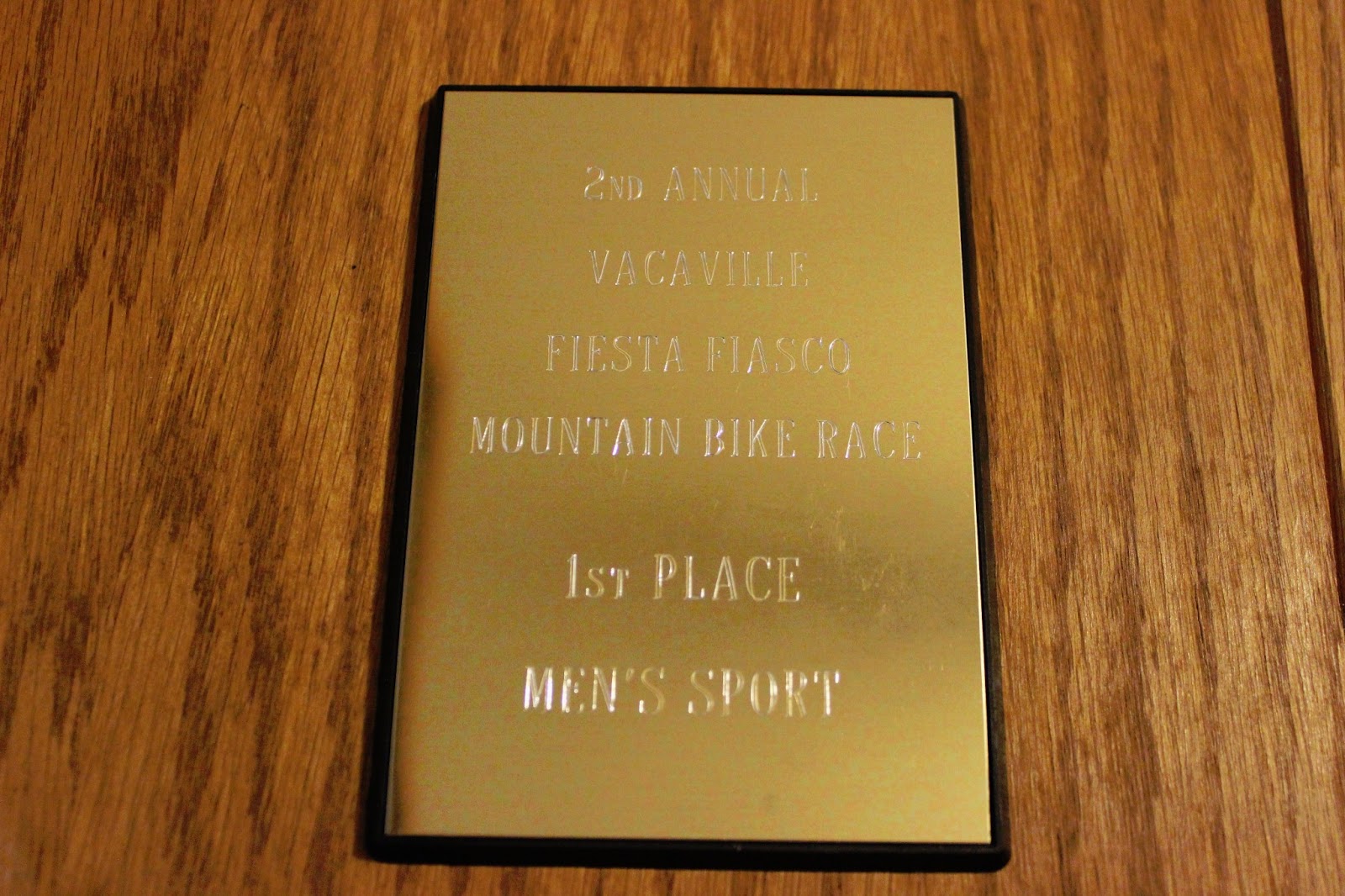
My finishing time of 56:47 was a little less than 14:12 per lap, and this was while purposely slowing significantly my last lap. Adding another lap would have put me at 1:11 and fourth place in Expert, less than two minutes behind the winner. Is there any guarantee I could have turned another lap at that pace? No, there are too many factors involved. However, I felt so good that day that I really do believe I could have won the Expert class.

The awards ceremony was cool. My dad was there, as well as a number of friends. I made quite a haul in swag, but the parts were nothing I could use on my Ibis. The highly coveted Salsa quill stem was of no use since Ibis was already using clamp-on stems. I also scored a set of IRD cantilever brakes, but my Ibis had roller cams. I sold all of it before leaving the race.


This would be my last race in the sport class for a while. I decided to turn expert for my next race.

Later.